


Typing African relapsing fever spirochetes
- PMID: 16318724
- PMCID: PMC3367362
- DOI: 10.3201/eid1111.050483
Typing African relapsing fever spirochetes
Abstract
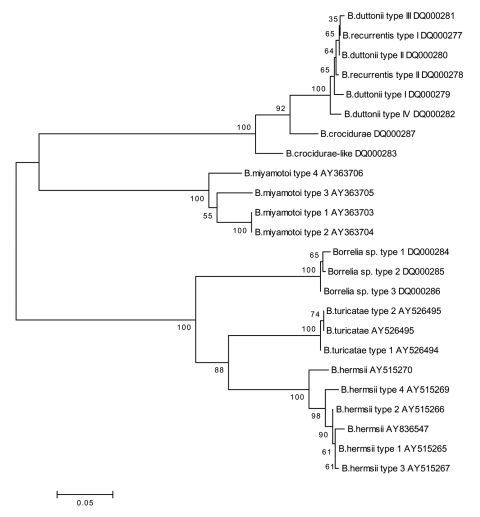
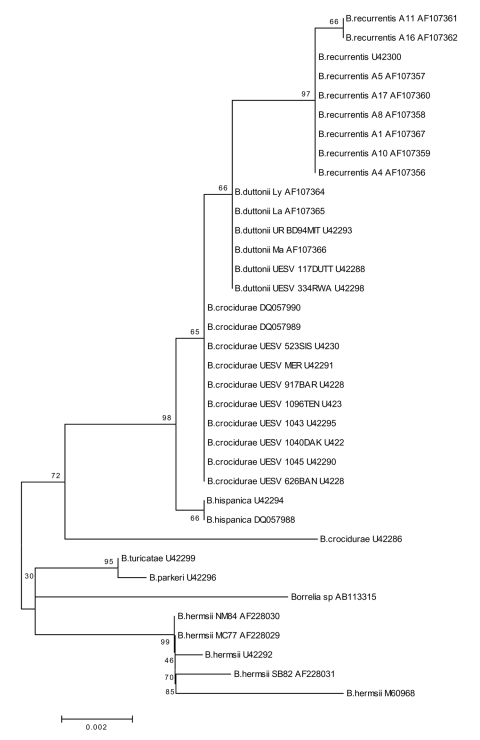
Relapsing fever Borrelia spp. challenge microbiologic typing because they possess segmented genomes that maintain essential genes on large linear plasmids. Antigenic variation further complicates typing. Intergenic spacer (IGS, between 16S-23S genes) heterogeneity provides resolution among Lyme disease-associated and some relapsing fever spirochetes. We used an IGS fragment for typing East African relapsing fever Borrelia spp. Borrelia recurrentis and their louse vectors showed 2 sequence types, while 4 B. duttonii and their tick vectors had 4 types. IGS typing was unable to discriminate between the tick- and louseborne forms of disease. B. crocidurae, also present in Africa, was clearly resolved from the B. recurrentis/B. duttonii complex. IGS analysis of ticks showed relapsing fever Borrelia spp. and a unique clade, distant from those associated with relapsing fever, possibly equivalent to a novel species in ticks from this region. Clinical significance of this spirochete is undetermined.
Figures
References
-
- Mitani H, Talbert A, Fukunaga M. New World relapsing fever Borrelia found in Ornithodoros porcinus ticks in central Tanzania. Microbiol Immunol. 2004;48:501–5. - PubMed
Publication types
MeSH terms
Substances
Associated data
- Actions
- Actions
- Actions
- Actions
- Actions
- Actions
- Actions
- Actions
- Actions
- Actions
Grants and funding
LinkOut - more resources
Full Text Sources
Miscellaneous