


Comparative sequence analysis of the hexon gene in the entire spectrum of human adenovirus serotypes: phylogenetic, taxonomic, and clinical implications
- PMID: 16188965
- PMCID: PMC1235814
- DOI: 10.1128/JVI.79.20.12635-12642.2005
Comparative sequence analysis of the hexon gene in the entire spectrum of human adenovirus serotypes: phylogenetic, taxonomic, and clinical implications
Erratum in
- J Virol. 2006 Mar;80(5):2586
Abstract
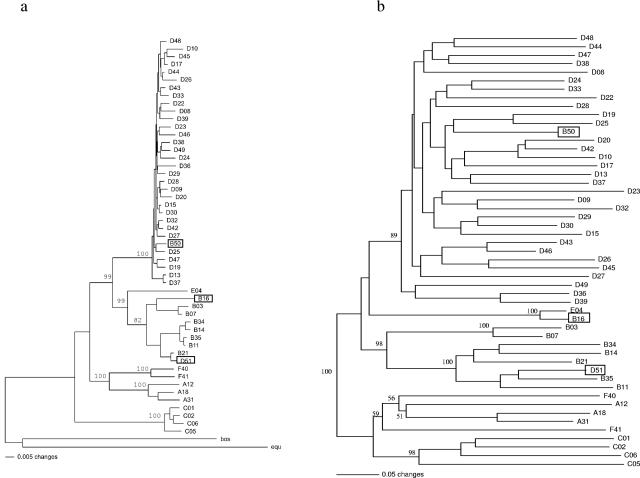
The adenovirus (AdV) hexon constitutes the major virus capsid protein. The epitopes located on the hexon protein are targets of neutralizing antibodies in vivo, serve in the recognition by cytotoxic T cells, and provide the basis for the classification of adenoviruses into the 51 serotypes known to date. We have sequenced the entire hexon gene from human serotypes with incomplete or no sequence information available (n = 34) and performed a comparative analysis of all sequences. The overall sequence divergence between the 51 human serotypes ranged from 0.7 to 25.4% at the protein level. The sequence information has been exploited to assess the phylogeny of the adenovirus family, and protein distances between the six AdV species (A to F) and among individual serotypes within each species were calculated. The analysis revealed that the differences among serotypes within individual species range from 0.3 to 5.4% in the conserved regions (765 amino acids [aa]) and from 1.5 to 59.6% in the variable regions (154 to 221 aa). Serotypes of different species showed an expectedly greater divergence both in the conserved (5.9 to 12.3%) and variable (49.0 to 74.7%) regions. Construction of a phylogenetic tree revealed three major clades comprising the species B+D+E, A+F, and C, respectively. For serotypes 50 and 51, the original assignment to species B and D, respectively, is not in accordance with the hexon DNA and protein sequence data, which placed serotype 50 within species D and serotype 51 within species B. Moreover, the hexon gene of serotype 16, a member of species B, was identified as the product of recombination between sequences of species B and E. In addition to providing a basis for improved molecular diagnostics and classification, the elucidation of the complete hexon gene sequence in all AdV serotypes yields information on putative epitopes for virus recognition, which may have important implications for future treatment strategies permitting efficient targeting of any AdV serotype.
Figures

References
-
- Adhikary, A. K., T. Inada, U. Banik, A. Mukouyama, Y. Ikeda, M. Noda, T. Ogino, E. Suzuki, T. Kaburaki, J. Numaga, and N. Okabe. 2004. Serological and genetic characterisation of a unique strain of adenovirus involved in an outbreak of epidemic keratoconjunctivitis. J. Clin. Pathol. 57:411-416. - PMC - PubMed
-
- Athappilly, F. K., R. Murali, J. J. Rux, Z. Cai, and R. M. Burnett. 1994. The refined crystal structure of hexon, the major coat protein of adenovirus type 2, at 2.9 A resolution. J. Mol. Biol. 242:430-455. - PubMed
-
- Bergelson, J. M., J. A. Cunningham, G. Droguett, E. A. Kurt-Jones, A. Krithivas, J. S. Hong, M. S. Horwitz, R. L. Crowell, and R. W. Finberg. 1997. Isolation of a common receptor for coxsackie B viruses and adenoviruses 2 and 5. Science 275:1320-1323. - PubMed
-
- Blanke, C., C. Clark, E. R. Broun, G. Tricot, I. Cunningham, K. Cornetta, A. Hedderman, and R. Hromas. 1995. Evolving pathogens in allogeneic bone marrow transplantation: increased fatal adenoviral infections. Am. J. Med. 99:326-328. - PubMed
Publication types
MeSH terms
Substances
Associated data
- Actions
- Actions
- Actions
- Actions
- Actions
- Actions
- Actions
- Actions
- Actions
- Actions
- Actions
- Actions
- Actions
- Actions
- Actions
- Actions
- Actions
- Actions
- Actions
- Actions
- Actions
- Actions
- Actions
- Actions
- Actions
- Actions
- Actions
- Actions
- Actions
- Actions
- Actions
- Actions
- Actions
- Actions
LinkOut - more resources
Full Text Sources
Other Literature Sources
