


Role of the envelope genetic context in the development of enfuvirtide resistance in human immunodeficiency virus type 1-infected patients
- PMID: 16912327
- PMCID: PMC1563884
- DOI: 10.1128/JVI.02706-05
Role of the envelope genetic context in the development of enfuvirtide resistance in human immunodeficiency virus type 1-infected patients
Abstract
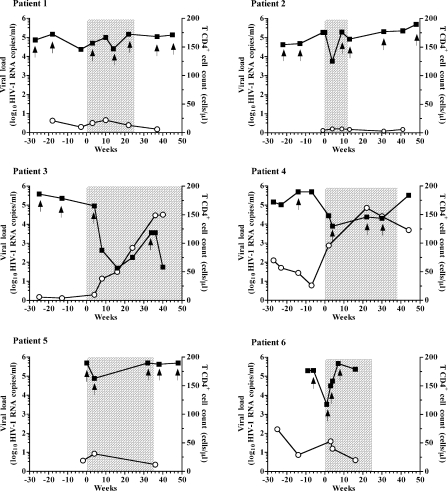
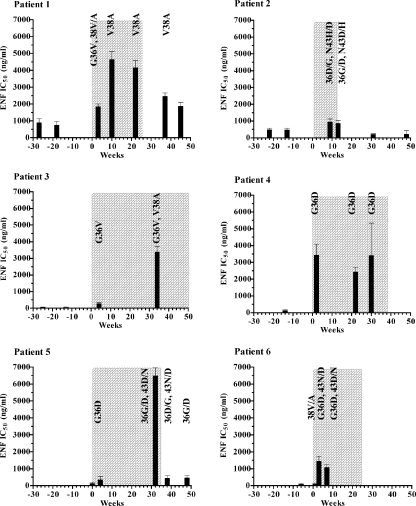
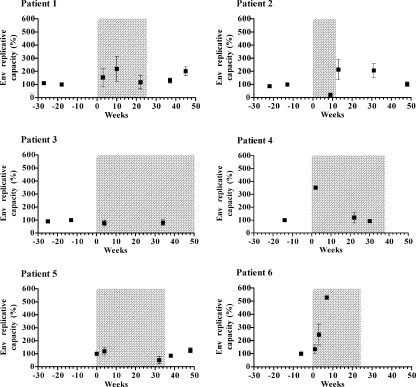
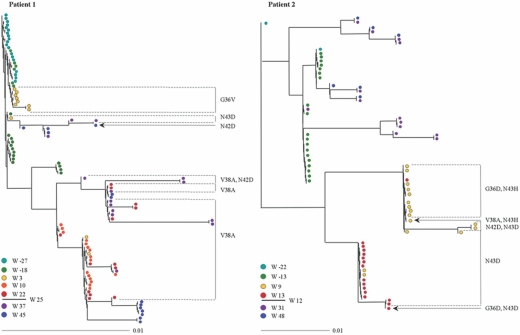
Acquired human immunodeficiency virus type 1(HIV-1) resistance to the fusion inhibitor enfuvirtide (ENF) is primarily associated with mutations within the highly conserved first heptad repeat (HR1) region of gp41. Viral env sequences, however, are remarkably variable, and the envelope genetic background could have an important impact on optimal expression of HR1 mutations. We have examined the genetic evolution of env sequences, ENF susceptibility, and Env replicative capacity in patients failing ENF treatment. Sequential plasma-derived virus populations, obtained from six patients initiating ENF treatment as part of a salvage therapy, were studied using a recombinant phenotypic assay evaluating the entire gp120 and the gp41 ectodomains. Regardless of major differences in the baseline ENF susceptibilities, viral populations with similar phenotypic ENF resistance (50% inhibitory concentration, >3,000 ng/ml) were selected under treatment in four of six patients. As expected, in all patients ENF-resistant viruses harbored one or more HR1 mutations (positions 36, 38, and 43). Interestingly, in five patients the emergence of resistance mutations was not associated with reduced Env replicative capacity. Phylogenetic analysis of env sequences in sequential samples from two patients showed that the HR1 mutations had emerged in the context of env quasi-species that were different from those prevalent at baseline. Thus, the envelope genetic context appears to play a critical role in the selection of HR1 mutations and the expression of ENF resistance, thereby conditioning the evolution of HIV-1 under fusion inhibitor selective pressure.
Figures
References
-
- Baldwin, C. E., R. W. Sanders, and B. Berkhout. 2003. Inhibiting HIV-1 entry with fusion inhibitors. Curr. Med. Chem. 10:1633-1642. - PubMed
-
- Centers for Disease Control and Prevention. 1993. From the Centers for Disease Control and Prevention. 1993 revised classification system for HIV infection and expanded surveillance case definition for AIDS among adolescents and adults. JAMA 269:729-730. - PubMed
-
- Chan, D. C., D. Fass, J. M. Berger, and P. S. Kim. 1997. Core structure of gp41 from the HIV envelope glycoprotein. Cell 89:263-273. - PubMed
Publication types
MeSH terms
Substances
Associated data
- Actions
- Actions
- Actions
- Actions
- Actions
- Actions
- Actions
- Actions
- Actions
- Actions
- Actions
- Actions
- Actions
- Actions
- Actions
- Actions
- Actions
- Actions
- Actions
- Actions
- Actions
- Actions
- Actions
- Actions
- Actions
- Actions
- Actions
- Actions
- Actions
- Actions
- Actions
- Actions
- Actions
- Actions
- Actions
- Actions
- Actions
- Actions
- Actions
- Actions
- Actions
- Actions
- Actions
- Actions
- Actions
- Actions
- Actions
- Actions
- Actions
- Actions
- Actions
- Actions
- Actions
- Actions
- Actions
- Actions
- Actions
- Actions
- Actions
- Actions
- Actions
- Actions
- Actions
- Actions
- Actions
- Actions
- Actions
- Actions
- Actions
- Actions
- Actions
- Actions
- Actions
- Actions
- Actions
- Actions
- Actions
- Actions
- Actions
- Actions
- Actions
- Actions
- Actions
- Actions
- Actions
- Actions
- Actions
- Actions
- Actions
- Actions
- Actions
- Actions
- Actions
- Actions
- Actions
- Actions
- Actions
- Actions
- Actions
- Actions
- Actions
- Actions
- Actions
- Actions
- Actions
- Actions
- Actions
- Actions
- Actions
- Actions
- Actions
- Actions
- Actions
- Actions
- Actions
- Actions
- Actions
- Actions
- Actions
- Actions
- Actions
- Actions
- Actions
- Actions
- Actions
- Actions
- Actions
- Actions
- Actions
- Actions
- Actions
- Actions
- Actions
- Actions
- Actions
- Actions
- Actions
- Actions
- Actions
- Actions
- Actions
- Actions
- Actions
- Actions
- Actions
- Actions
- Actions
- Actions
- Actions
- Actions
- Actions
- Actions
- Actions
- Actions
- Actions
- Actions
- Actions
- Actions
- Actions
- Actions
- Actions
- Actions
- Actions
- Actions
- Actions
- Actions
- Actions
- Actions
- Actions
- Actions
- Actions
- Actions
- Actions
- Actions
- Actions
- Actions
- Actions
- Actions
- Actions
- Actions
- Actions
- Actions
- Actions
- Actions
- Actions
- Actions
- Actions
- Actions
- Actions
- Actions
- Actions
- Actions
- Actions
- Actions
- Actions
- Actions
- Actions
- Actions
- Actions
- Actions
- Actions
- Actions
- Actions
- Actions
- Actions
- Actions
- Actions
- Actions
- Actions
- Actions
- Actions
- Actions
- Actions
- Actions
- Actions
- Actions
- Actions
- Actions
- Actions
- Actions
- Actions
LinkOut - more resources
Full Text Sources
Research Materials
