


Isolation, characterization, and ecology of sulfur-respiring crenarchaea inhabiting acid-sulfate-chloride-containing geothermal springs in Yellowstone National Park
- PMID: 17720836
- PMCID: PMC2075080
- DOI: 10.1128/AEM.01321-07
Isolation, characterization, and ecology of sulfur-respiring crenarchaea inhabiting acid-sulfate-chloride-containing geothermal springs in Yellowstone National Park
Abstract
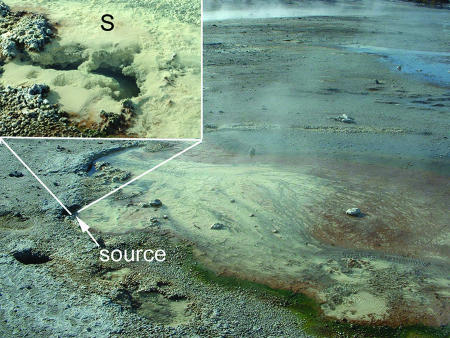
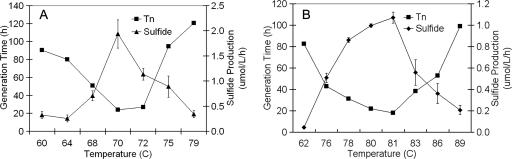
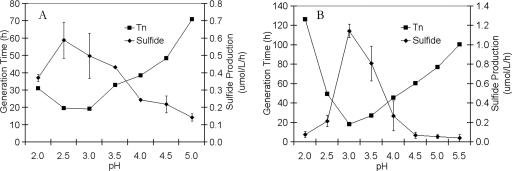
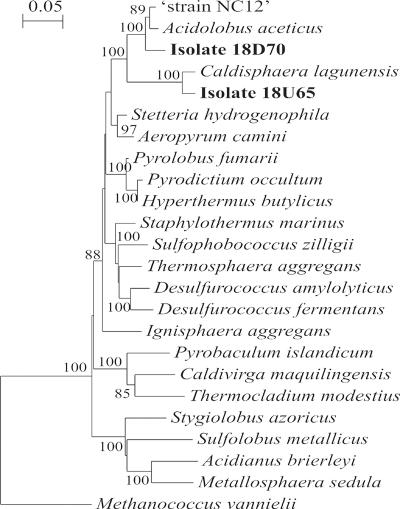
Elemental sulfur (S(0)) is associated with many geochemically diverse hot springs, yet little is known about the phylogeny, physiology, and ecology of the organisms involved in its cycling. Here we report the isolation, characterization, and ecology of two novel, S(0)-reducing Crenarchaea from an acid geothermal spring referred to as Dragon Spring. Isolate 18U65 grows optimally at 70 to 72 degrees C and at pH 2.5 to 3.0, while isolate 18D70 grows optimally at 81 degrees C and pH 3.0. Both isolates are chemoorganotrophs, dependent on complex peptide-containing carbon sources, S(0), and anaerobic conditions for respiration-dependent growth. Glycerol dialkyl glycerol tetraethers (GDGTs) containing four to six cyclopentyl rings were present in the lipid fraction of isolates 18U65 and 18D70. Physiological characterization suggests that the isolates are adapted to the physicochemical conditions of Dragon Spring and can utilize the natural organic matter in the spring as a carbon and energy source. Quantitative PCR analysis of 16S rRNA genes associated with the S(0) flocs recovered from several acid geothermal springs using isolate-specific primers indicates that these two populations together represent 17 to 37% of the floc-associated DNA. The physiological characteristics of isolates 18U65 and 18D70 are consistent with their potential widespread distribution and putative role in the cycling of sulfur in acid geothermal springs throughout the Yellowstone National Park geothermal complex. Based on phenotypic and genetic characterization, the designations Caldisphaera draconis sp. nov. and Acidilobus sulfurireducens sp. nov. are proposed for isolates 18U65 and 18D70, respectively.
Figures
References
-
- Allewalt, J. P., M. M. Bateson, N. P. Revsbech, K. Slack, and D. M. Ward. 2006. Effect of temperature and light on growth of and photosynthesis by Synechococcus isolates typical of those predominating in the Octopus Spring microbial mat community of Yellowstone National Park. Appl. Environ. Microbiol. 72:544-550. - PMC - PubMed
-
- Amend, J. P., and E. L. Shock. 2001. Energetics of overall metabolic reactions of thermophilic and hyperthermophilic Archaea and Bacteria. FEMS Microbiol. Rev. 25:175-243. - PubMed
-
- Aoshima, M., Y. Nishibe, M. Hasegawa, A. Yamagishi, and T. Oshima. 1996. Cloning and sequencing of a gene encoding 16S ribosomal RNA from a novel hyperthermophilic archaebacterium NC12. Gene 180:183-187. - PubMed
-
- Arab, H., H. Volker, and M. Thomm. 2000. Thermococcus aegaeicus sp. nov. and Staphylothermus hellenicus sp. nov., two novel hyperthermophilic archaea isolated from geothermally heated vents off Palaeochori Bay, Milos, Greece. Int. J. Syst. Evol. Microbiol. 50:2101-2108. - PubMed
-
- Atlas, R. M. 1997. Handbook of microbiological media. CRC Press, New York, NY.
Publication types
MeSH terms
Substances
Associated data
- Actions
- Actions
LinkOut - more resources
Full Text Sources
Molecular Biology Databases
