


Cryptic speciation in a model invertebrate chordate
- PMID: 17517633
- PMCID: PMC1890500
- DOI: 10.1073/pnas.0610158104
Cryptic speciation in a model invertebrate chordate
Abstract
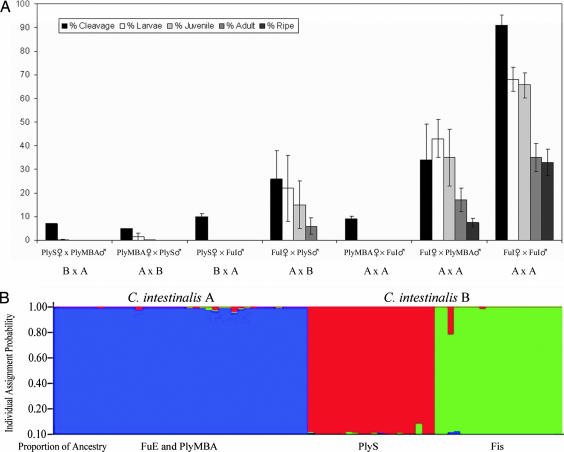
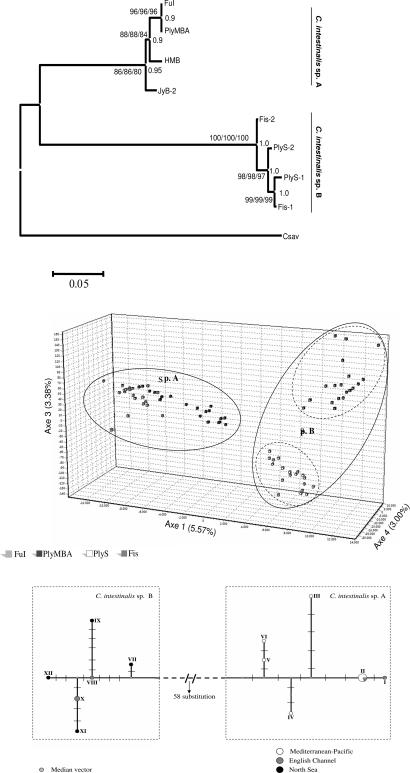
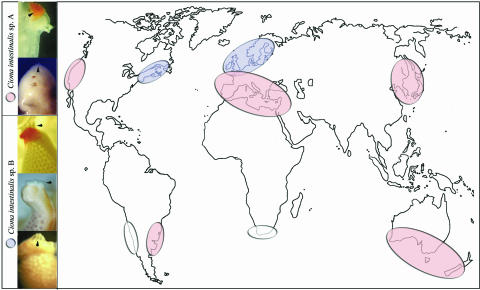
We applied independent species concepts to clarify the phylogeographic structure of the ascidian Ciona intestinalis, a powerful model system in chordate biology and for comparative genomic studies. Intensive research with this marine invertebrate is based on the assumption that natural populations globally belong to a single species. Therefore, understanding the true taxonomic classification may have implications for experimental design and data management. Phylogenies inferred from mitochondrial and nuclear DNA markers accredit the existence of two cryptic species: C. intestinalis sp. A, genetically homogeneous, distributed in the Mediterranean, northeast Atlantic, and Pacific, and C. intestinalis sp. B, geographically structured and encountered in the North Atlantic. Species-level divergence is further entailed by cross-breeding estimates. C. intestinalis A and B from allopatric populations cross-fertilize, but hybrids remain infertile because of defective gametogenesis. Although anatomy illustrates an overall interspecific similarity lacking in diagnostic features, we provide consistent tools for in-field and in-laboratory species discrimination. Finding of two cryptic taxa in C. intestinalis raises interest in a new tunicate genome as a gateway to studies in speciation and ecological adaptation of chordates.
Conflict of interest statement
The authors declare no conflict of interest.
Figures
References
-
- Knowlton N. Annu Rev Ecol Syst. 1993;24:189–216.
-
- Palumbi SR. Annu Rev Ecol Syst. 1994;25:547–572.
-
- Millar RH. Ciona: Liverpool Marine Biological Committee Series No. 35. Liverpool, UK: Univ Press of Liverpool; 1953.
-
- Carlton JT, Geller JB. Science. 1993;261:78–82. - PubMed
-
- Stachowicz JJ, Whitlatch RB, Osman RW. Science. 1999;286:1577–1579. - PubMed
Publication types
MeSH terms
Associated data
- Actions
- Actions
- Actions
- Actions
- Actions
- Actions
- Actions
- Actions
- Actions
- Actions
- Actions
- Actions
- Actions
- Actions
- Actions
- Actions
- Actions
- Actions
- Actions
- Actions
- Actions
- Actions
- Actions
- Actions
- Actions
- Actions
- Actions
- Actions
- Actions
- Actions
- Actions
- Actions
- Actions
- Actions
- Actions
- Actions
- Actions
- Actions
- Actions
- Actions
- Actions
Grants and funding
LinkOut - more resources
Full Text Sources
