. 2008 May 23;4(5):e1000072.
doi: 10.1371/journal.ppat.1000072.

Genetic compatibility and virulence of reassortants derived from contemporary avian H5N1 and human H3N2 influenza A viruses

Affiliations

Genetic compatibility and virulence of reassortants derived from contemporary avian H5N1 and human H3N2 influenza A viruses

Li-Mei Chen et al. PLoS Pathog. .

Abstract

The segmented structure of the influenza virus genome plays a pivotal role in its adaptation to new hosts and the emergence of pandemics. Despite concerns about the pandemic threat posed by highly pathogenic avian influenza H5N1 viruses, little is known about the biological properties of H5N1 viruses that may emerge following reassortment with contemporary human influenza viruses. In this study, we used reverse genetics to generate the 63 possible virus reassortants derived from H5N1 and H3N2 viruses, containing the H5N1 surface protein genes, and analyzed their viability, replication efficiency, and mouse virulence. Specific constellations of avian-human viral genes proved deleterious for viral replication in cell culture, possibly due to disruption of molecular interaction networks. In particular, striking phenotypes were noted with heterologous polymerase subunits, as well as NP and M, or NS. However, nearly one-half of the reassortants replicated with high efficiency in vitro, revealing a high degree of compatibility between avian and human virus genes. Thirteen reassortants displayed virulent phenotypes in mice and may pose the greatest threat for mammalian hosts. Interestingly, one of the most pathogenic reassortants contained avian PB1, resembling the 1957 and 1968 pandemic viruses. Our results reveal the broad spectrum of phenotypes associated with H5N1/H3N2 reassortment and a possible role for the avian PB1 in the emergence of pandemic influenza. These observations have important implications for risk assessment of H5N1 reassortant viruses detected in surveillance programs.


Conflict of interest statement

The authors have declared that no competing interests exist.

Figures

Figure 1
Figure 1. Characteristics of high yield avian-human reassortant viruses in cell culture.
Human and chicken symbols denote the parental WY03 or TH04 source of each gene segment. The genotype of reassortants (r) is denoted by the genes derived from WY03 virus, designated by their segment number; 1:PB2. 2:PB1. 3:PA. 4:HA. 5:NP. 6:NA. 7:M. 8:NS. All others genes derived from TH04 do not bear a number. For example, r3/8 indicates the reassortant virus carries PA and NS genes from WY03 virus, and the remaining segments from TH04 virus. Rescue efficiency represents the virus titer (log10 pfu/ml) from cell cultures at 72 hours after transfection; geometric mean from 3 independent experiments.
Figure 2
Figure 2. Characteristics of moderate to low yield avian-human reassortant viruses in cell culture.
Symbols and virus nomenclatures are the same as described in Figure 1. Rescue efficiency represents virus titer (log10 pfu/ml) from cell cultures at 72 hours after transfection; geometric mean from 3 independent experiments. Plaque formation by reassortant viruses with <100 pfu/ml rescue efficiency was not determined (ND).
Figure 3
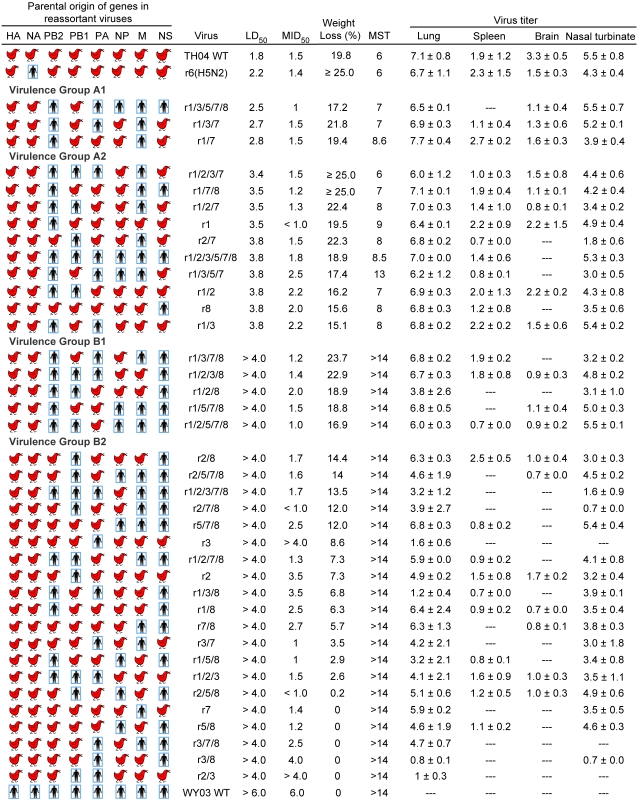
Figure 3. Replication of avian-human reassortant viruses in mice.
Symbols and virus nomenclature are as in Figure 1. The mouse infectious dose (MID50) and lethal dose (LD50) are expressed as the log10 pfu required to give one MID50 or one LD50. Maximum mean weight loss was determined from five mice per group (percent weight loss relative to dpi 0) following intranasal infection with 104 pfu. MST denotes the mean survival time in days following infection with 104 pfu. Virus titer in lung, spleen, brain or nasal turbinate are geometric means of the log10 pfu at 4 dpi of three mice infected with 104 pfu. LD50 values of rH5N1 in group A1 were significantly different from A2 and those from A1 and A2 were significantly different from TH04 WT (P<0.001) by analysis of variance. The — indicate that tissue titers were below limit of detection of the assay (0.7 log10 pfu/ml). Viruses are listed in ascending LD50 values. Viruses with identical LD50 are listed by descending weight loss.
Figure 4
Figure 4. Replication kinetics of avian-human reassortant viruses in differentiated human tracheobronchial epithelial (HTBE) cells.
HTBE cells were infected in duplicate with parental TH04 and WY03 (A) or rH5N1 viruses (B, C, D) at an moi of 0.02; progeny viruses were collected and titrated on MDCK cells.
Figure 5
Figure 5. Polymerase activity of avian-human viral ribonucleoprotein (RNP) complexes.
(A) A549 cells were transfected in duplicate with pPol1-NS-Renilla and pSV40-Luc reporter plasmids, together with plasmids expressing PB2, PB1, PA and NP from either WY03 (human symbol) or TH04 (chicken symbol) viruses. Cells were incubated at 33°C (hatched bars) or 37°C (solid bars) for 24 hours and cell lysates were analyzed to measure Renilla and firefly luciferase activities. The latter was used to normalize transfection efficiency. Values shown represent the activities of each RNP relative to that of WY03 measured at 37°C (100%). (B) Viral RNP activities derived from WY03 (human symbol) or VN04 (chicken symbol) viruses are shown as described in panel A.

References

    1. Taubenberger JK, Reid AH, Lourens RM, Wang R, Jin G, et al. Characterization of the 1918 influenza virus polymerase genes. Nature. 2005;437:889–893. - PubMed
    1. Reid AH, Taubenberger JK, Fanning TG. Evidence of an absence: the genetic origins of the 1918 pandemic influenza virus. Nat Rev Microbiol. 2004;2:909–914. - PMC - PubMed
    1. Kawaoka Y, Krauss S, Webster RG. Avian-to-human transmission of the PB1 gene of influenza A viruses in the 1957 and 1968 pandemics. J Virol. 1989;63:4603–4608. - PMC - PubMed
    1. Ito T, Couceiro JN, Kelm S, Baum LG, Krauss S, et al. Molecular basis for the generation in pigs of influenza A viruses with pandemic potential. J Virol. 1998;72:7367–7373. - PMC - PubMed
    1. Scholtissek C, Burger H, Kistner O, Shortridge KF. The nucleoprotein as a possible major factor in determining host specificity of influenza H3N2 viruses. Virology. 1985;147:287–294. - PubMed

Publication types

MeSH terms

Substances