


Suppression of dualtropic human immunodeficiency virus type 1 by the CXCR4 antagonist AMD3100 is associated with efficiency of CXCR4 use and baseline virus composition
- PMID: 18443125
- PMCID: PMC2443920
- DOI: 10.1128/AAC.01226-07
Suppression of dualtropic human immunodeficiency virus type 1 by the CXCR4 antagonist AMD3100 is associated with efficiency of CXCR4 use and baseline virus composition
Abstract
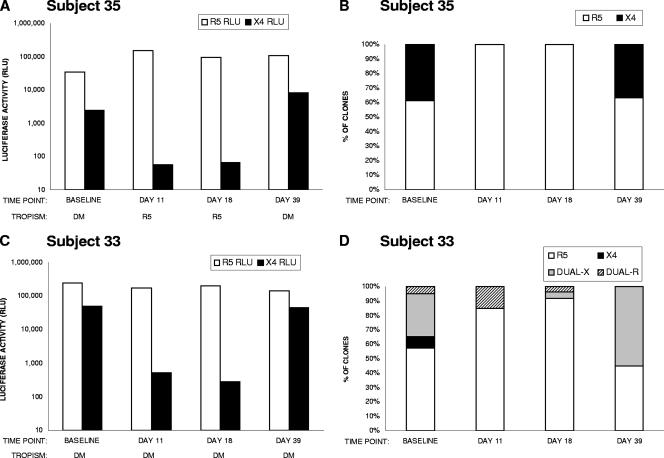
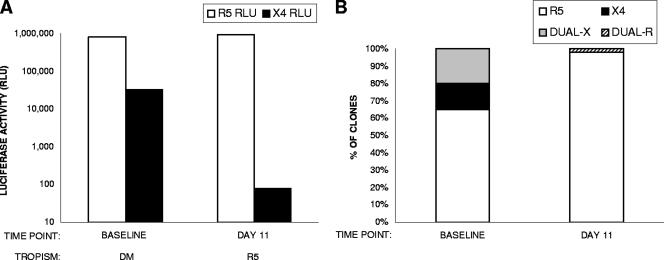
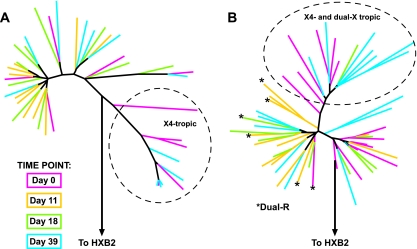
In a phase I/II evaluation of the CXCR4 antagonist AMD3100, human immunodeficiency virus RNA levels were significantly reduced in a single study subject who harbored CXCR4 (X4)-tropic virus, but not in subjects who harbored either dual/mixed (DM)-tropic or CCR5 (R5)-tropic virus (C. W. Hendrix et al., J. Acquir. Immune Defic. Syndr. 37:1253-1262, 2004). In this study, we analyzed the envelope clones of DM-tropic virus in baseline and treated virus populations from 14 subjects. Ten subjects exhibited significant reductions in CXCR4-mediated infectivity after 10 days of AMD3100 therapy relative to baseline (X4 suppressor group), while four subjects had no reduction of CXCR4-mediated infectivity (X4 nonsuppressor group). The baseline viruses of the X4 suppressor group infected CXCR4-expressing cells less efficiently than those of the X4 nonsuppressor group. Clonal analysis indicated that the baseline viruses from the X4 suppressor group contained a higher proportion of R5-tropic variants mixed with CXCR4-using variants, while the X4 nonsuppressor group was enriched for CXCR4-using variants. AMD3100 suppressed X4-tropic variants in all subjects studied, but not all dualtropic variants. Furthermore, dualtropic variants that used CXCR4 efficiently were suppressed by AMD3100, while dualtropic variants that used CXCR4 poorly were not. This study demonstrated that AMD3100 has the ability to suppress both X4-tropic and certain dualtropic variants in vivo. The suppression of CXCR4-using variants by AMD3100 is dependent on both the tropism composition of the virus population and the efficiency of CXCR4 usage of individual variants.
Figures
References
-
- Berger, E. A., P. M. Murphy, and J. M. Farber. 1999. Chemokine receptors as HIV-1 coreceptors: roles in viral entry, tropism, and disease. Annu. Rev. Immunol. 17:657-700. - PubMed
-
- Bridger, G. J., R. T. Skerlj, S. Padmanabhan, S. A. Martellucci, G. W. Henson, S. Struyf, M. Witvrouw, D. Schols, and E. De Clercq. 1999. Synthesis and structure-activity relationships of phenylenebis(methylene)-linked bis-azamacrocycles that inhibit HIV-1 and HIV-2 replication by antagonism of the chemokine receptor CXCR4. J. Med. Chem. 42:3971-3981. - PubMed
-
- Deng, H., R. Liu, W. Ellmeier, S. Choe, D. Unutmaz, M. Burkhart, P. Di Marzio, S. Marmon, R. E. Sutton, C. M. Hill, C. B. Davis, S. C. Peiper, T. J. Schall, D. R. Littman, and N. R. Landau. 1996. Identification of a major co-receptor for primary isolates of HIV-1. Nature 381:661-666. - PubMed
-
- Donzella, G. A., D. Schols, S. W. Lin, J. A. Este, K. A. Nagashima, P. J. Maddon, G. P. Allaway, T. P. Sakmar, G. Henson, E. De Clercq, and J. P. Moore. 1998. AMD3100, a small molecule inhibitor of HIV-1 entry via the CXCR4 co-receptor. Nat. Med. 4:72-77. - PubMed
-
- Dorr, P., M. Westby, S. Dobbs, P. Griffin, B. Irvine, M. Macartney, J. Mori, G. Rickett, C. Smith-Burchnell, C. Napier, R. Webster, D. Armour, D. Price, B. Stammen, A. Wood, and M. Perros. 2005. Maraviroc (UK-427,857), a potent, orally bioavailable, and selective small-molecule inhibitor of chemokine receptor CCR5 with broad-spectrum anti-human immunodeficiency virus type 1 activity. Antimicrob. Agents Chemother. 49:4721-4732. - PMC - PubMed
Publication types
MeSH terms
Substances
Associated data
- Actions
- Actions
- Actions
- Actions
- Actions
- Actions
- Actions
- Actions
- Actions
- Actions
- Actions
- Actions
- Actions
- Actions
- Actions
- Actions
- Actions
- Actions
- Actions
- Actions
- Actions
- Actions
- Actions
- Actions
- Actions
- Actions
- Actions
- Actions
- Actions
- Actions
- Actions
- Actions
- Actions
- Actions
- Actions
- Actions
- Actions
- Actions
- Actions
- Actions
- Actions
- Actions
- Actions
- Actions
- Actions
- Actions
- Actions
- Actions
- Actions
- Actions
- Actions
- Actions
- Actions
- Actions
- Actions
- Actions
- Actions
- Actions
- Actions
- Actions
- Actions
- Actions
- Actions
- Actions
- Actions
- Actions
- Actions
- Actions
- Actions
- Actions
- Actions
- Actions
- Actions
- Actions
- Actions
- Actions
- Actions
- Actions
- Actions
- Actions
- Actions
- Actions
- Actions
- Actions
- Actions
- Actions
- Actions
- Actions
- Actions
- Actions
- Actions
- Actions
- Actions
- Actions
Grants and funding
LinkOut - more resources
Full Text Sources
Other Literature Sources
Medical
Molecular Biology Databases
