. 2010 Aug;84(15):7427-36.
doi: 10.1128/JVI.00697-10. Epub 2010 May 19.

High prevalence, coinfection rate, and genetic diversity of retroviruses in wild red colobus monkeys (Piliocolobus badius badius) in Tai National Park, Cote d'Ivoire

Affiliations

High prevalence, coinfection rate, and genetic diversity of retroviruses in wild red colobus monkeys (Piliocolobus badius badius) in Tai National Park, Cote d'Ivoire

Siv Aina J Leendertz et al. J Virol. 2010 Aug.

Abstract

Simian retroviruses are precursors of all human retroviral pathogens. However, little is known about the prevalence and coinfection rates or the genetic diversity of major retroviruses-simian immunodeficiency virus (SIV), simian T-cell lymphotropic virus type 1 (STLV-1), and simian foamy virus (SFV)-in wild populations of nonhuman primates. Such information would contribute to the understanding of the natural history of retroviruses in various host species. Here, we estimate these parameters for wild West African red colobus monkeys (Piliocolobus badius badius) in the Taï National Park, Côte d'Ivoire. We collected samples from a total of 54 red colobus monkeys; samples consisted of blood and/or internal organs from 22 monkeys and additionally muscle and other tissue samples from another 32 monkeys. PCR analyses revealed a high prevalence of SIV, STLV-1, and SFV in this population, with rates of 82%, 50%, and 86%, respectively. Forty-five percent of the monkeys were coinfected with all three viruses while another 32% were coinfected with SIV in combination with either STLV or SFV. As expected, phylogenetic analyses showed a host-specific pattern for SIV and SFV strains. In contrast, STLV-1 strains appeared to be distributed in genetically distinct and distant clades, which are unique to the Taï forest and include strains previously described from wild chimpanzees in the same area. The high prevalence of all three retroviral infections in P. b. badius represents a source of infection to chimpanzees and possibly to humans, who hunt them.


Figures
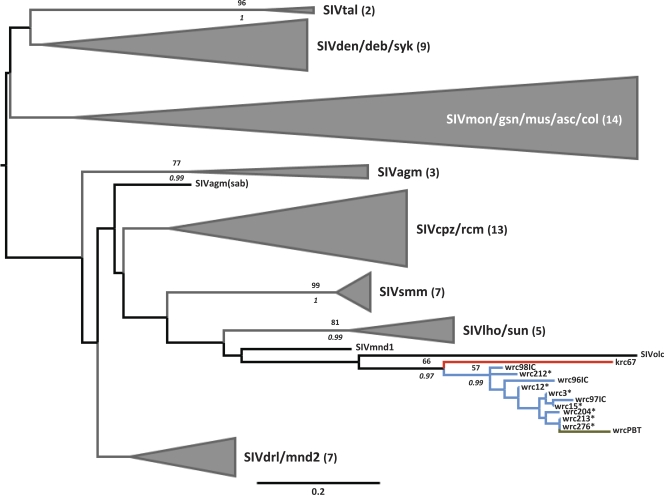
FIG. 1.
FIG. 1.
Maximum-likelihood tree based on the analysis of SIV partial pol sequences (152 bp). The topologies of Bayesian maximum clade credibility trees obtained under two different tree priors were similar when shallow evolutionary depths were considered (deep branching patterns were not similar). Branches leading to strains isolated from red colobus monkeys in Côte d'Ivoire are blue, those leading to strains isolated from Ugandan red colobus monkeys are red, and the one branch leading to a Gambian strain is green. Major SIV groups are represented graphically to improve readability: in every case the number of strains represented is indicated in parentheses after group names. Numbers above branches represent bootstrap values (Bp); italicized numbers below branches represent posterior probability values (pp) obtained using the birth-death model. Bp and pp are indicated only where Bp is ≥50 and pp is ≥0.95. Asterisks indicate strains identified in the present study. Note that this tree is mid-point rooted due to the lack of information regarding the position of the root in SIV phylogeny. Tal, talapoin monkey (Miopithecus talapoin); den, Dent's monkey (Cercopithecus denti); deb, De Brazza's guenon (Cercopithcus neglectus); syk, Sykes'monkey (Cercopithecus mitis); mon, mona monkey (Cercopithecus mona); gsn, greater spot-nosed guenon (Cercopithecus nictitans); mus, mustached guenon (Cercopithecus cephus); asc, red-tailed guenon (Cercopithecus ascanius); col, mantled guereza (Colobus guereza); agm, African green monkey (Chlorocebus aethiops); cpz, chimpanzee (Pan troglodytes); rcm, red-capped mangabey (Cercocebus torquatus); smm, sooty mangabey monkey (Cercocebus atys); lho, L'Hoest's monkey (Cercopithecus lhoesti); sun, sun-tailed guenon (Cercopithecus solatus); mnd, mandrill (Mandrillus sphinx); drl, drill (Mandrillus leucophaeus); olc, olive colobus monkey (Procolobus verus); wrc, Western red colobus (P. b. badius); krc, Eastern red colobus (P. r. tephrosceles); wrcPBT, Western red colobus (P. b. temminckii).
FIG. 2.
FIG. 2.
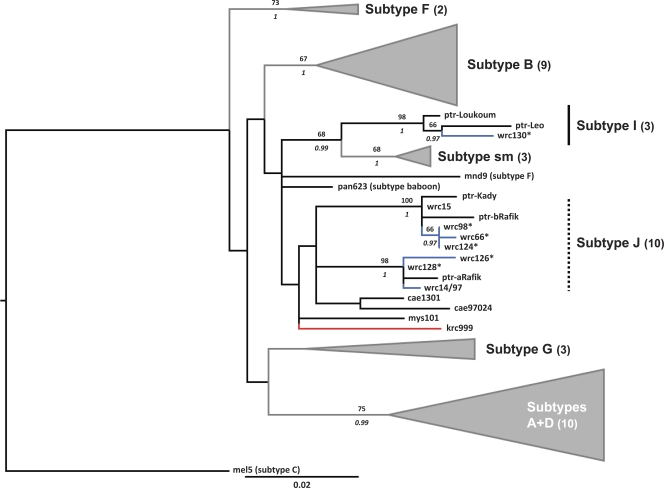
Maximum-likelihood tree based on the analysis of PTLV-1 partial LTR sequences (422 bp). The topologies of Bayesian maximum clade credibility trees obtained under two different tree priors were similar when shallow evolutionary depths were considered (deep branching patterns were not similar). Branches leading to strains isolated from red colobus monkeys in Côte d'Ivoire are blue, and those leading to strains isolated from Ugandan red colobus monkeys are red. Major PTLV-1 groups are represented graphically to improve readability: in every case the number of strains represented is indicated in parentheses after group names. Numbers above branches represent Bp values, italicized numbers below branches represent pp values obtained using the birth-death model. Bp and pp are indicated only where Bp is ≥50 and pp is ≥0.95. Asterisks indicate strains identified in the present study. Three of these strains were actually identified in more than one individual: wrc15 (published as STLVwrc [27]) is identical to wrc129* and wrc212* (plus ptr-Dorry); wrc66* is identical to wrc72*; and wrc126* is identical to wrc211*. Sm, sooty mangabey monkey (Cercocebus atys); ptr, chimpanzee (Pan troglodytes); mnd, mandrill (Mandrillus sphinx); cae, African green monkey (Chlorocebus aethiops); msy, Barbary macaque (Macaca sylvanus); wrc, Western red colobus (P. b. badius); krc, Eastern red colobus P. r. tephrosceles).
FIG. 3.
FIG. 3.
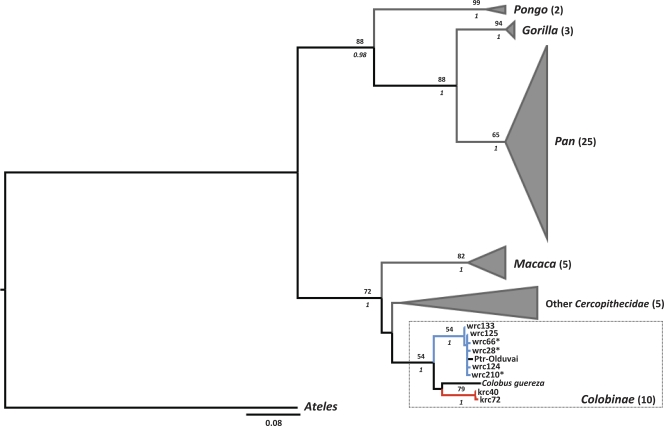
Maximum-likelihood tree based on the analysis of SFV partial pol sequences (252 bp). The topologies of Bayesian maximum clade credibility trees obtained under two different tree priors were similar. Branches leading to strains isolated from red colobus monkeys in Côte d'Ivoire are blue, those leading to strains isolated from Ugandan red colobus monkeys are red. Noncolobine tips are represented graphically to improve readability: in every case the number of strains represented is indicated between parentheses after family, subfamily or genus names. Numbers above branches represent bootstrap values (Bp), italicized numbers below branches represent posterior probability values (pp) obtained using the birth-death model. Bp and pp are indicated only where Bp is ≥50 and pp is ≥0.95. Asterisks indicate strains identified in the present study. Two of these strains were actually identified in more than one individual: wrc125 is identical to wrc3*, wrc12, wrc45*, wrc68*, wrc71*, wrc126, wrc127, wrc128, wrc129, wrc130, wrc131, wrc213*, wrc236*, and wrc276* (15 wrc sequences plus ptr-Leo); wrc133 is identical to wrc132*. Ptr, chimpanzee (P. troglodytes); krc, Eastern red colobus (P. r. tephrosceles); wrc, Western red colobus (P. b. badius).

References

    1. Altschul, S. F., W. Gish, W. Miller, E. W. Myers, and D. J. Lipman. 1990. Basic local alignment search tool. J. Mol. Biol. 215:403-410. - PubMed
    1. Boesch, C., and H. Boesch-Achermann. 2000. The chimpanzees of the Taï forest: behavioural ecology and evolution. Oxford University Press, Oxford, United Kingdom.
    1. Calattini, S., E. Nerrienet, P. Mauclere, M. C. Georges-Courbot, A. Saib, and A. Gessain. 2004. Natural simian foamy virus infection in wild-caught gorillas, mandrills and drills from Cameroon and Gabon. J. Gen. Virol. 85:3313-3317. - PubMed
    1. Cardini, A., and S. Elton. 2009. The radiation of red colobus monkeys (Primates, Colobinae): morphological evolution in a clade of endangered African primates. Zool. J. Linn. Soc. 157:197-224.
    1. Charleston, M. A., and D. L. Robertson. 2002. Preferential host switching by primate lentiviruses can account for phylogenetic similarity with the primate phylogeny. Syst. Biol. 51:528-535. - PubMed

Publication types

MeSH terms

Associated data

LinkOut - more resources