. 2006 Dec;74(12):6642-55.
doi: 10.1128/IAI.01250-06. Epub 2006 Sep 25.

Identification of MglA-regulated genes reveals novel virulence factors in Francisella tularensis

Affiliations

Identification of MglA-regulated genes reveals novel virulence factors in Francisella tularensis

Anna Brotcke et al. Infect Immun. 2006 Dec.

Abstract

The facultative intracellular bacterium Francisella tularensis causes the zoonotic disease tularemia. F. tularensis resides within host macrophages in vivo, and this ability is essential for pathogenesis. The transcription factor MglA is required for the expression of several Francisella genes that are necessary for replication in macrophages and for virulence in mice. We hypothesized that the identification of MglA-regulated genes in the Francisella genome by transcriptional profiling of wild-type and mglA mutant bacteria would lead to the discovery of new virulence factors utilized by F. tularensis. A total of 102 MglA-regulated genes were identified, the majority of which were positively regulated, including all of the Francisella pathogenicity island (FPI) genes. We mutated novel MglA-regulated genes and tested the mutants for their ability to replicate and induce cytotoxicity in macrophages and to grow in mice. Mutations in MglA-regulated genes within the FPI (pdpB and cds2) as well as outside the FPI (FTT0989, oppB, and FTT1209c) were either attenuated or hypervirulent in macrophages compared to the wild-type strain. All of these mutants exhibited decreased fitness in vivo in competition experiments with wild-type bacteria. We have identified five new Francisella virulence genes, and our results suggest that characterizations of additional MglA-regulated genes will yield further insights into the pathogenesis of this bacterium.


Figures
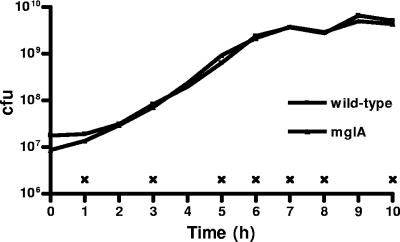
FIG. 1.
FIG. 1.
Wild-type and mglA mutant Francisella bacteria replicate with similar kinetics in rich media at 37°C. Shown is a representative growth curve for wild-type and mglA mutant Francisella strains. ×, time points when RNA was isolated from each strain.
FIG. 2.
FIG. 2.
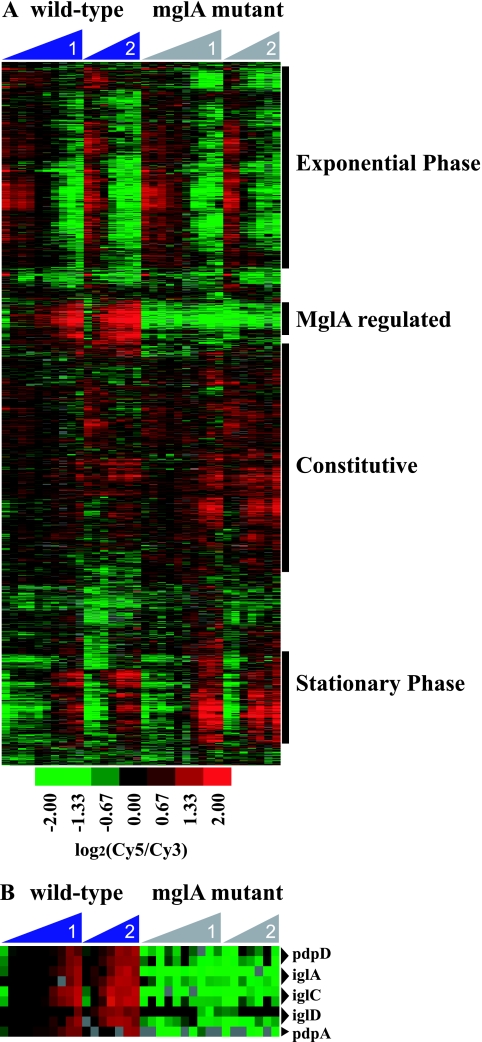
Transcriptional profiles of wild-type and mglA mutant Francisella strains in rich media. (A) Hierarchical gene cluster of microarrays from two independent wild-type and mglA mutant growth curves. Columns represent individual time points, increasing from left to right during the growth curve. Rows represent individual genes. Genes were clustered into groups that were expressed in lag/exponential phase or stationary phase or that were constitutively expressed. One distinct cluster was expressed in wild-type bacteria but not in the mglA mutant. (B) Expression patterns of the mglAB operon and the known MglA-regulated genes pdpD, iglA, iglC, iglD, and pdpA. Duplicate gene spots that passed the filtering criteria are included.
FIG. 3.
FIG. 3.
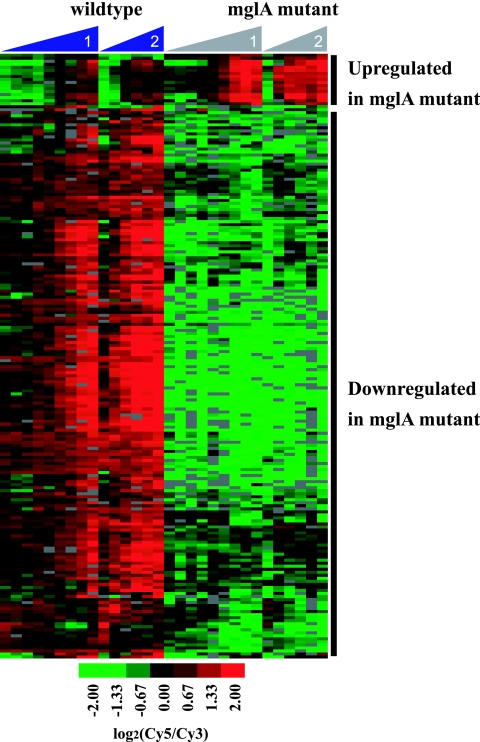
Clustering of the 102 MglA-regulated genes as determined by SAM. Seventeen spots representing 10 genes were expressed at higher levels in the mutant than in the wild type, and 183 spots representing 92 genes were downregulated in the mutant compared to the wild-type. Columns represent individual time points, increasing from left to right during the growth curve, and rows represent individual genes.
FIG. 4.
FIG. 4.
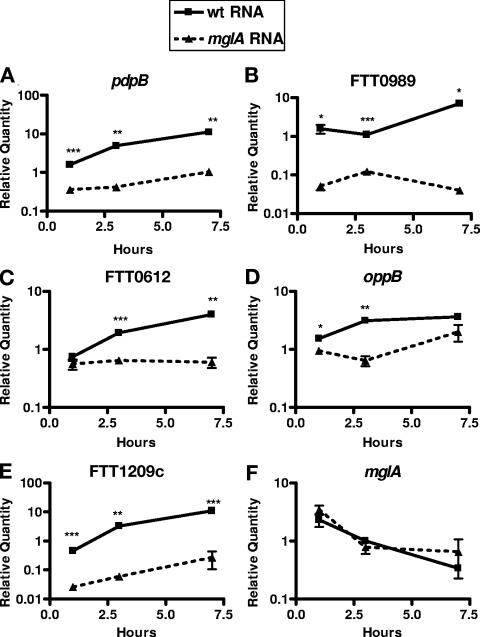
Quantification of selected MglA-regulated genes by real-time reverse transcription-PCR. Differences in transcript abundance of MglA-regulated genes were confirmed by real-time RT-PCR using RNA from the second growth curve. Gene-specific primers for (A) pdpB, (B) FTT0989, (C) FTT0612, (D) oppB, (E) FTT1209c, and (F) mglA were used to amplify either wild-type (wt) RNA, represented by a solid line, or mglA mutant RNA, represented by a dashed line. Testing of samples was performed in triplicate. Experiments were performed at least three times. Means and standard deviations from a representative experiment are shown. *, P < 0.05; **, P < 0.01; ***, P < 0.001 (compared with the wild type).
FIG. 5.
FIG. 5.
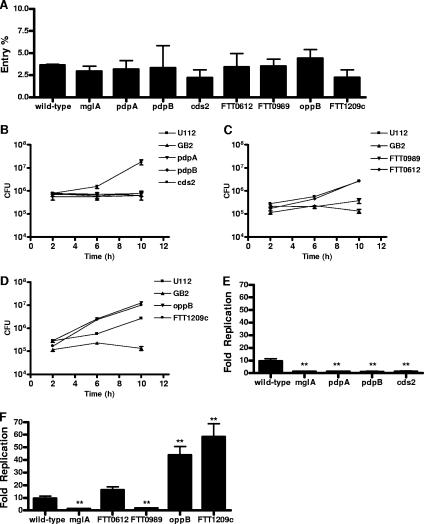
MglA-regulated genes contribute to Francisella replication in macrophages. Bone-marrow-derived macrophages were infected at an MOI of 25:1. Samples were taken at 2 h, 6 h, and 10 h postinfection. (A) Percent bacterial entry into macrophages was calculated by dividing the 2-h counts by the input. Macrophages were infected with (B) pdpB and cds2 mutants, (C) FTT0612 and FTT0989 mutants, and (D) oppB and FTT1209c mutants. Bacterial replication (n-fold) was calculated by dividing the 10-h bacterial counts by the averages of the 2-h bacterial counts for (E) pdpB and cds2 mutants and (F) FTT0612, FTT0989, oppB, and FTT1209c mutants. The wild type, the mglA mutant, and pdpA mutants were included as controls. Samples were performed in triplicate. Experiments were performed at least three times. Means and standard deviations from a representative experiment are shown. *, P < 0.05; **, P < 0.01; ***, P < 0.001 (compared with the wild type).
FIG. 6.
FIG. 6.
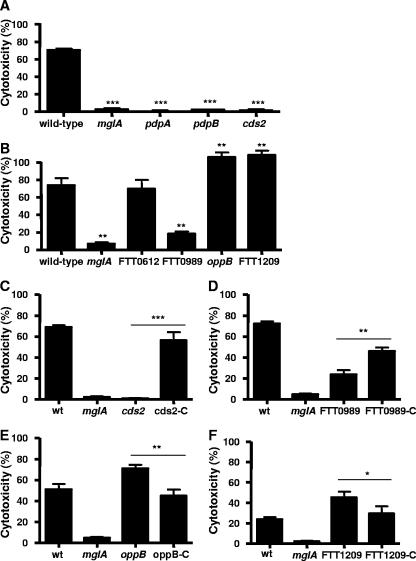
MglA-regulated genes are involved in macrophage cytotoxicity. Macrophages were prestimulated with heat-killed, wild-type Francisella cells ∼18 h prior to infection. Cytotoxicity was measured by LDH release at 8 h postinfection. The mglA and pdpA mutants were included as controls. Macrophages were infected at an MOI of 100:1 with (A) pdpB and cds2 mutants and (B) FTT0612, FTT0989, oppB, and FTT1209c mutants. Mutants were complemented, and cytotoxicity was measured at (C) 8 h postinfection with an MOI of 100:1; (D) 10 h postinfection with an MOI of 20:1; (E) 8 h postinfection with an MOI of 100:1; and (F) 10 h postinfection with an MOI of 10:1. Testing of samples was performed in triplicate in each experiment. Experiments were performed at least three times. Means and standard deviations from a representative experiment are shown. *, P < 0.05; **, P < 0.01; ***, P < 0.001 (compared with wild-type for A and B or mutant compared to the complemented mutant by the bar in C to F). wt, wild type.
FIG. 7.
FIG. 7.
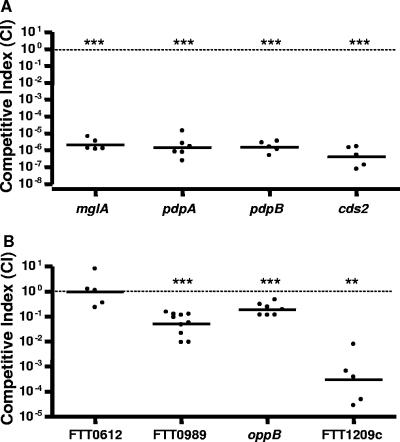
MglA-regulated genes contribute to Francisella virulence in mice. Mice were infected subcutaneously with equal amounts of mutant and wild-type Francisella cells. At 2 days postinfection, spleens were taken for counts, and the competitive index was calculated. (A) Competitive indices of pdpB and cds2 FPI mutants. A spontaneous streptomycin-resistant mglA mutant (see Materials and Methods for a description) and the pdpA mutants were included as controls. (B) Competitive indices of FTT0612, FTT0989, oppB, and FTT1209c mutants. At least five mice were used to calculate the CI value for each mutant strain. Each spot represents the CI value from an individual mouse, and bars represent the geometric means. Significance was calculated by comparing the log of the CI value to 0. *, P < 0.05; **, P < 0.01; ***, P < 0.001 (compared with 0).

References

    1. Ansai, T., W. Yu, S. Urnowey, S. Barik, and T. Takehara. 2003. Construction of a pepO gene-deficient mutant of Porphyromonas gingivalis: potential role of endopeptidase O in the invasion of host cells. Oral Microbiol. Immunol. 18:398-400. - PubMed
    1. Anthony, L. D., R. D. Burke, and F. E. Nano. 1991. Growth of Francisella spp. in rodent macrophages. Infect. Immun. 59:3291-3296. - PMC - PubMed
    1. Anthony, L. S., M. Z. Gu, S. C. Cowley, W. W. Leung, and F. E. Nano. 1991. Transformation and allelic replacement in Francisella spp. J. Gen. Microbiol. 137:2697-2703. - PubMed
    1. Awano, S., T. Ansai, H. Mochizuki, W. Yu, K. Tanzawa, A. J. Turner, and T. Takehara. 1999. Sequencing, expression and biochemical characterization of the Porphyromonas gingivalis pepO gene encoding a protein homologous to human endothelin-converting enzyme. FEBS Lett. 460:139-144. - PubMed
    1. Baron, G. S., and F. E. Nano. 1999. An erythromycin resistance cassette and mini-transposon for constructing transcriptional fusions to cat. Gene 229:59-65. - PubMed

Publication types

MeSH terms

Associated data