. 2014 Aug 26;111(34):12556-61.
doi: 10.1073/pnas.1319488111. Epub 2014 Aug 11.

Inhibitor of MYC identified in a Kröhnke pyridine library

Affiliations

Inhibitor of MYC identified in a Kröhnke pyridine library

Jonathan R Hart et al. Proc Natl Acad Sci U S A. .

Abstract

In a fluorescence polarization screen for the MYC-MAX interaction, we have identified a novel small-molecule inhibitor of MYC, KJ-Pyr-9, from a Kröhnke pyridine library. The Kd of KJ-Pyr-9 for MYC in vitro is 6.5 ± 1.0 nM, as determined by backscattering interferometry; KJ-Pyr-9 also interferes with MYC-MAX complex formation in the cell, as shown in a protein fragment complementation assay. KJ-Pyr-9 specifically inhibits MYC-induced oncogenic transformation in cell culture; it has no or only weak effects on the oncogenic activity of several unrelated oncoproteins. KJ-Pyr-9 preferentially interferes with the proliferation of MYC-overexpressing human and avian cells and specifically reduces the MYC-driven transcriptional signature. In vivo, KJ-Pyr-9 effectively blocks the growth of a xenotransplant of MYC-amplified human cancer cells.

Keywords: combinatorial library; gene signature; protein–protein interactions; transcriptional control; xenograft.


Conflict of interest statement

The authors declare no conflict of interest.

Figures
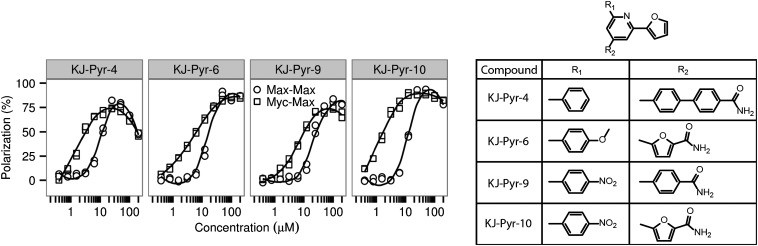
Fig. 1.
Fig. 1.
(Left) Fluorescence polarization data of KJ-Pyr-4, KJ-Pyr-6, KJ-Pyr-9, and KJ-Pyr-10, comparing binding to MYC–MAX with the interaction with MAX–MAX. (Right) Structures of the four compounds.
Fig. 2.
Fig. 2.
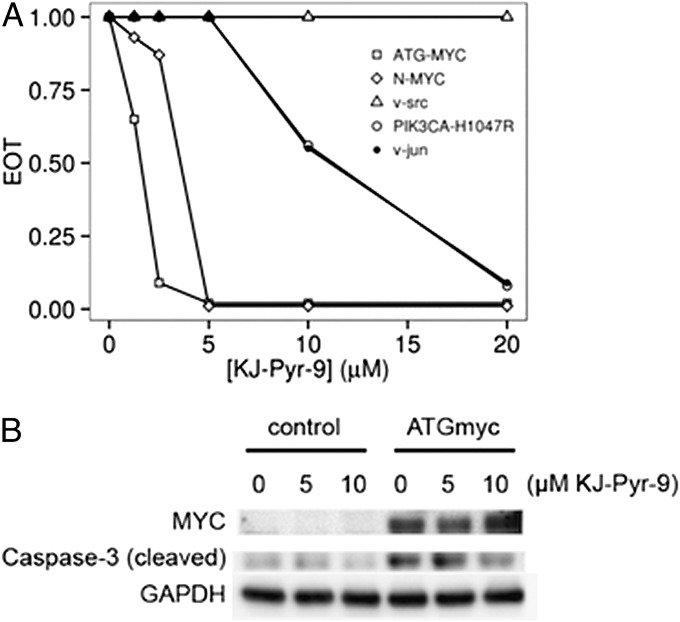
(A) Dose–response of KJ-Pyr-9 versus oncogenic transformation induced by MYC, N-MYC, v-Src, PIK3CA-H1047R, and v-Jun. Data from a representative experiment conducted with cells derived from a single chicken embryo. In these transformation assays, the MYC expression vector produced the larger isoform of MYC, initiated by the first initiation codon that had been mutated from CTG to ATG. Identical results were obtained by expressing MYC from the wild-type mRNA sequence and from an mRNA sequence in which the first initiation codon CTG is mutated to a nonfunctional CAG, thus forcing expression of only the smaller isoform of MYC. EOT, efficiency of transformation. (B) CEF were infected at a multiplicity of infection of 10 with the RCAS retroviral vector expressing ATG-MYC. Cells were transferred on days 3 and 5 postinfection and treated or not treated with KJ-Pyr-9, and cleaved caspase 3 was determined by Western blot on day 9.
Fig. 3.
Fig. 3.
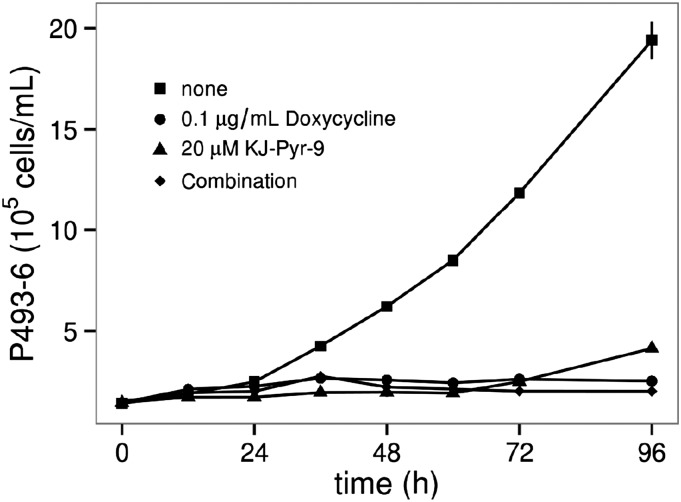
Effect of KJ-Pyr-9 on the proliferation of P493-6 cells. Expression of MYC in these cells is suppressed by doxycycline, resulting in cessation of cell proliferation. Cell proliferation is also halted by KJ-Pyr-9 alone or in combination with doxycycline. Error bars represent standard error of the mean (SEM).
Fig. 4.
Fig. 4.
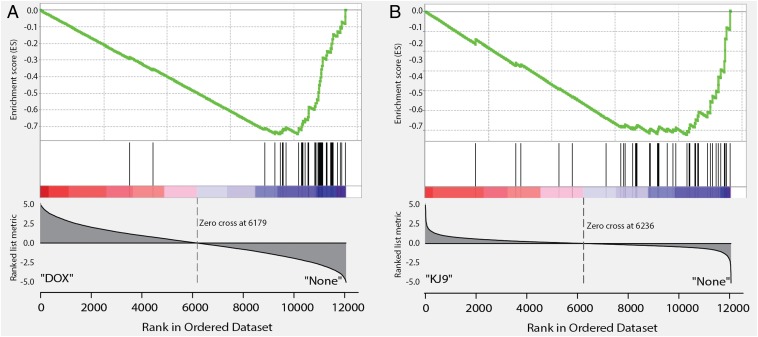
GSEA of RNAseq comparing the effect of doxycycline (A) with the effect of KJ-Pyr-9 (B) on the MYC gene signature published by O’Donnell et al. (26). Both drugs target the established MYC signature; the overlap between their effects is highly significant, but not 100%.
Fig. 5.
Fig. 5.
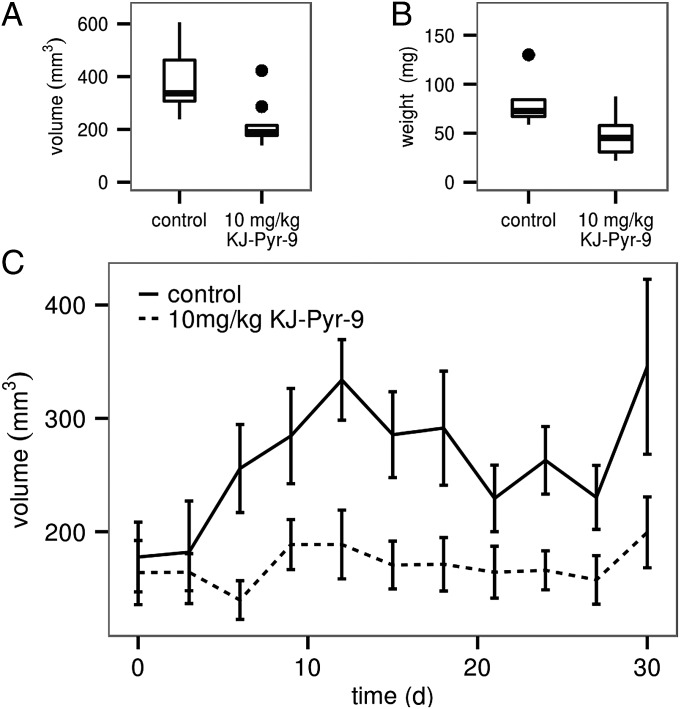
KJ-Pyr-9 interferes with the growth of a xenograft of MDA-MB-231 cells. Mice were injected with 5 × 10⁶ MDA-MB-231 cells s.c. into the left and right flanks. When tumors reached a volume of 100 mm3, half of the mice were given daily i.p. injections of 10 mg/kg KJ-Pyr-9 and the other half received vehicle only. Tumor growth was followed for 31 d. (A) Tumor volumes of treated and untreated animals. (B) Tumor weights of treated and untreated animals. (C) Time course of tumor volumes. Error bars indicate 95% confidence intervals.

References

    1. Lee LA, Dang CV. Myc target transcriptomes. Curr Top Microbiol Immunol. 2006;302:145–167. - PubMed
    1. Eisenman RN. The Max network: Coordinated transcriptional regulation of cell growth and proliferation. Harvey Lect. 2000–2001;96:1–32. - PubMed
    1. Eisenman RN. Deconstructing Myc. Genes Dev. 2001;15(16):2023–2030. - PubMed
    1. Blackwood EM, Eisenman RN. Max: A helix-loop-helix zipper protein that forms a sequence-specific DNA-binding complex with Myc. Science. 1991;251(4998):1211–1217. - PubMed
    1. Ji H, et al. Cell-type independent MYC target genes reveal a primordial signature involved in biomass accumulation. PLoS ONE. 2011;6(10):e26057. - PMC - PubMed

Publication types

MeSH terms

Associated data