


A trispecies Aspergillus microarray: comparative transcriptomics of three Aspergillus species
- PMID: 18332432
- PMCID: PMC2393752
- DOI: 10.1073/pnas.0709964105
A trispecies Aspergillus microarray: comparative transcriptomics of three Aspergillus species
Abstract
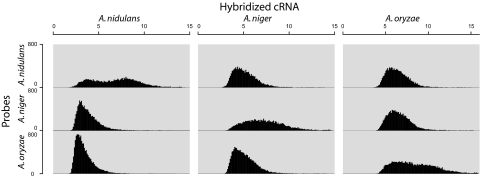
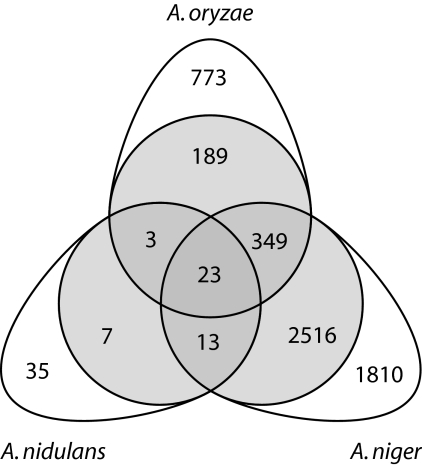
The full-genome sequencing of the filamentous fungi Aspergillus nidulans, Aspergillus niger, and Aspergillus oryzae has opened possibilities for studying the cellular physiology of these fungi on a systemic level. As a tool to explore this, we are making available an Affymetrix GeneChip developed for transcriptome analysis of any of the three above-mentioned aspergilli. Transcriptome analysis of triplicate batch cultivations of all three aspergilli on glucose and xylose media was used to validate the performance of the microarray. Gene comparisons of all three species and cross-analysis with the expression data identified 23 genes to be a conserved response across Aspergillus sp., including the xylose transcriptional activator XlnR. A promoter analysis of the up-regulated genes in all three species indicates the conserved XlnR-binding site to be 5'-GGNTAAA-3'. The composition of the conserved gene-set suggests that xylose acts as a molecule, indicating the presence of complex carbohydrates such as hemicellulose, and triggers an array of degrading enzymes. With this case example, we present a validated tool for transcriptome analysis of three Aspergillus species and a methodology for conducting cross-species evolutionary studies within a genus using comparative transcriptomics.
Conflict of interest statement
The authors declare no conflict of interest.
Figures

References
-
- Baker SE, Bennett JW. The Aspergilli: Genomics, Medical Aspects, Biotechnology, and Research Methods. In: Osmani SA, Goldman GH, editors. Boca Raton, FL: CRC Press; 2008. pp. 3–13.
-
- Hjort CM. In: Genetically Engineered Food. Heller KJ, editor. Wennheim, Germany: Wiley, VCH; 2003. pp. 86–99.
-
- Nevalainen KH, Te'o VSJ, Bergquist P. Heterologous protein expression in filamentous fungi. Trends Biotechnol. 2005;23:468–474. - PubMed
-
- Pontecorvo G. The genetics of Aspergillus nidulans. Adv Genet. 1953;5:141–238. - PubMed
-
- Galagan JE, et al. Sequencing of Aspergillus nidulans and comparative analysis with A. fumigatus and A. oryzae. Nature. 2005;438:1105–1115. - PubMed
Publication types
MeSH terms
Substances
Associated data
- Actions
LinkOut - more resources
Full Text Sources
Molecular Biology Databases
Research Materials
