. 2011 Jun 14;2(3):e00077-11.
doi: 10.1128/mBio.00077-11. Print 2011.

An insect nidovirus emerging from a primary tropical rainforest

Affiliations

An insect nidovirus emerging from a primary tropical rainforest

Florian Zirkel et al. mBio. .

Abstract

Tropical rainforests show the highest level of terrestrial biodiversity and may be an important contributor to microbial diversity. Exploitation of these ecosystems may foster the emergence of novel pathogens. We report the discovery of the first insect-associated nidovirus, tentatively named Cavally virus (CAVV). CAVV was found with a prevalence of 9.3% during a survey of mosquito-associated viruses along an anthropogenic disturbance gradient in Côte d'Ivoire. Analysis of habitat-specific virus diversity and ancestral state reconstruction demonstrated an origin of CAVV in a pristine rainforest with subsequent spread into agriculture and human settlements. Virus extension from the forest was associated with a decrease in virus diversity (P<0.01) and an increase in virus prevalence (P<0.00001). CAVV is an enveloped virus with large surface projections. The RNA genome comprises 20,108 nucleotides with seven major open reading frames (ORFs). ORF1a and -1b encode two large proteins that share essential features with phylogenetically higher representatives of the order Nidovirales, including the families Coronavirinae and Torovirinae, but also with families in a basal phylogenetic relationship, including the families Roniviridae and Arteriviridae. Genetic markers uniquely conserved in nidoviruses, such as an endoribonuclease- and helicase-associated zinc-binding domain, are conserved in CAVV. ORF2a and -2b are predicted to code for structural proteins S and N, respectively, while ORF3a and -3b encode proteins with membrane-spanning regions. CAVV produces three subgenomic mRNAs with 5' leader sequences (of different lengths) derived from the 5' end of the genome. This novel cluster of mosquito-associated nidoviruses is likely to represent a novel family within the order Nidovirales.


Figures

FIG 1
FIG 1
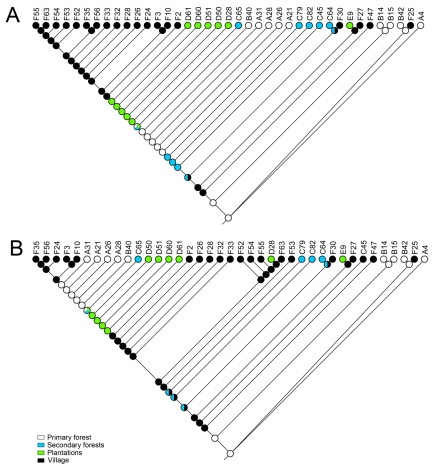
CAVV ancestral state reconstruction based on a maximum-parsimony algorithm. Minimum evolution phylogenies based on the numbers of synonymous exchanges (A) and the percent nucleotide distance (B) were calculated in Mega 5 (66). CAVV strain A4 served as an outgroup. Tip traits in Mesquite (http://mesquiteproject.org/mesquite/mesquite.html) were defined by the habitats from which the virus isolates were taken (identified by color code at the bottom left of panel B). The circles at each root point identify by colored segments the likelihood of the root point taxon having existed in the habitat shown.
FIG 2
FIG 2
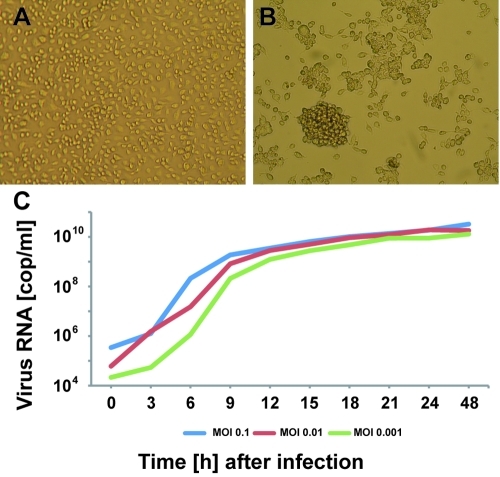
CAVV growth on insect cells. CPE in C6/36 cells infected with CAVV was observed at 48 hpi (B) compared to mock-infected C6/36 cells (A). Numbers of CAVV genome copies per milliliter in cell culture supernatant of C6/36 cells infected with CAVV at MOIs of 0.1, 0.01, and 0.001 were measured by RT-PCR at 0 to 48 hpi (C).
FIG 3
FIG 3
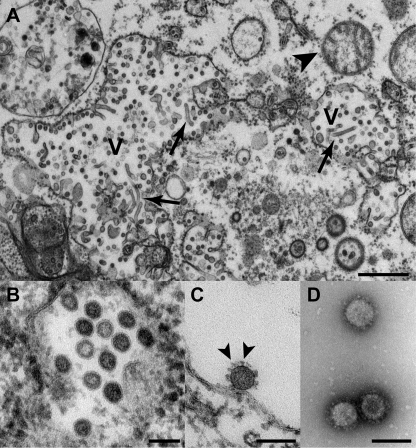
CAVV replication and morphology as observed by transmission electron microscopy. Ultrathin sections of C6/36 cells infected with CAVV at 48 hpi (A to C), showing an overview of the cytoplasm of infected cells (A; bar, 1 µm; V, vesicle with virus formation; arrowhead, mitochondrion; arrow, tubular structures likely of viral origin) and a higher magnification of vesicles containing spherical, potentially enveloped particles (B; bar, 100 nm) and separation or adsorption of putative virions on cell membranes (C; bar, 100 nm; arrowhead, spikes on virus surface). Negative staining (1% uranyl acetate) of CAVV sedimented by ultracentrifugation through a 36% sucrose cushion (D; bar, 100 nm). It should be noted that better EM results were obtained at 48 hpi than at 24 hpi.
FIG 4
FIG 4
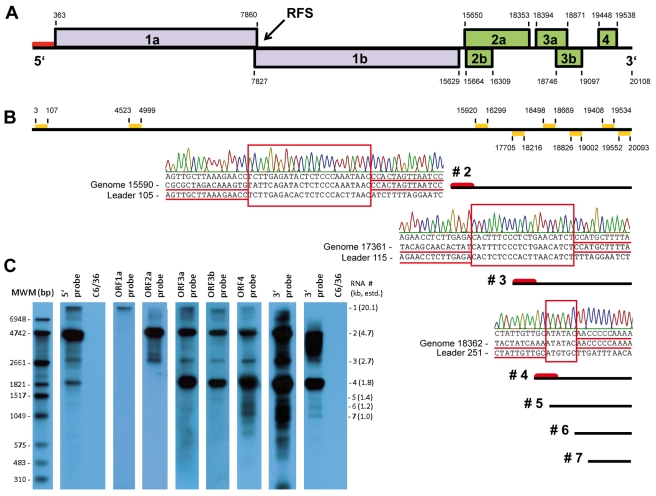
CAVV genome organization and subgenomic mRNA synthesis. (A) Positions and sizes of CAVV ORFs. (B) Positions of probes used for Northern blotting and placement of putative sgRNAs. Putative leader sequences are marked by red bars. Electropherograms shown next to mRNAs 2, 3, and 4 indicate typical leader-body fusion sites identified by RT-PCR. No clear leader-body fusions were identified for RNAs shown without leader symbols (see Fig. S2 in the supplemental material). (C) Detection of CAVV genome and sgRNAs by Northern blot analysis of intracellular viral RNA from infected C6/36 cells. Specific probes for the 5′ and 3′ prime ends, as well as for each ORF, were employed. The 3′-terminal probe is shown after short and long exposures of the blot. A molecular size marker (MWM) is shown in the left lane. Molecular size indicators on the right summarize estimated sizes of putative subgenomic mRNAs.
FIG 5
FIG 5
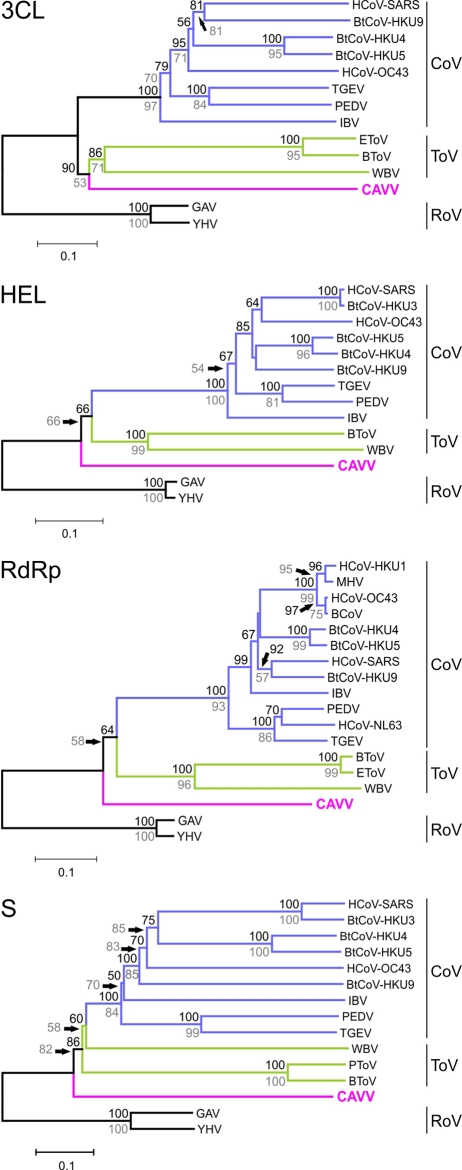
Phylogenetic relationship of CAVV to prototype nidovirus strains for selected genomic regions. Phylogenetic analyses were performed using the NJ algorithm, a BLOSUM62 substitution matrix, and no distance correction. Indels were fully deleted. Significance was tested by bootstrap analysis using 1,000 resampling steps as implemented in MEGA 5.0 (66). Bootstrap values are shown above nodes. Analyses were also performed using the maximum-likelihood algorithm in FastML with the same settings. Results of this analysis are not shown because of congruent topologies. Bootstrap support values (1,000 replicates) from maximum-likelihood analysis are shown in grey below nodes.

References

    1. Boesch C, Boesch-Achermann H. 2000. The chimpanzees of the Tai forest: behavioural ecology and evolution. Oxford University Press, Oxford, United Kingdom
    1. Myers N. 1990. The biodiversity challenge: expanded hot-spots analysis. Environmentalist 10:243–256 - PubMed
    1. Myers N, Mittermeier RA, Mittermeier CG, da Fonseca GA, Kent J. 2000. Biodiversity hotspots for conservation priorities. Nature 403:853–858 - PubMed
    1. Chapman CA, Balcomb SR, Gillespie TR, Skorupa JP, Struhsaker TT. 2000. Long-term effects of logging on African primate communities: a 28-year comparison from Kibale National Park, Uganda. Conserv. Biol. 14:207–217
    1. Hall JS, Harris DJ, Medjibe V, Ashton PMS. 2003. The effects of selective logging on forest structure and tree species composition in a Central African forest: implications for management of conservation areas. Forest Ecol. Manag. 183:249–264

Publication types

Associated data