


First investigation of the microbiology of the deepest layer of ocean crust
- PMID: 21079766
- PMCID: PMC2974637
- DOI: 10.1371/journal.pone.0015399
First investigation of the microbiology of the deepest layer of ocean crust
Abstract
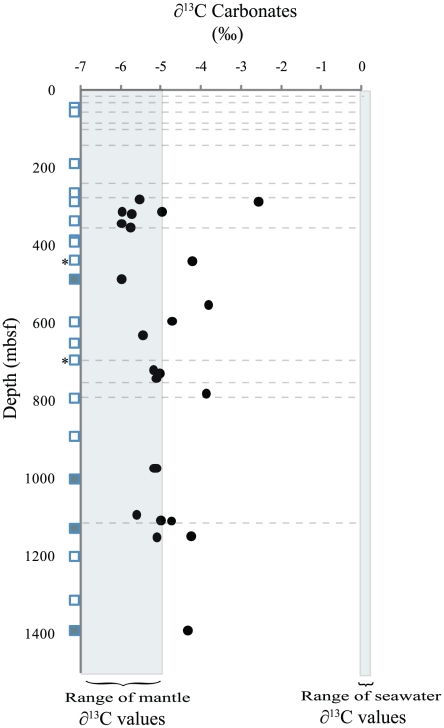
The gabbroic layer comprises the majority of ocean crust. Opportunities to sample this expansive crustal environment are rare because of the technological demands of deep ocean drilling; thus, gabbroic microbial communities have not yet been studied. During the Integrated Ocean Drilling Program Expeditions 304 and 305, igneous rock samples were collected from 0.45-1391.01 meters below seafloor at Hole 1309D, located on the Atlantis Massif (30 °N, 42 °W). Microbial diversity in the rocks was analyzed by denaturing gradient gel electrophoresis and sequencing (Expedition 304), and terminal restriction fragment length polymorphism, cloning and sequencing, and functional gene microarray analysis (Expedition 305). The gabbroic microbial community was relatively depauperate, consisting of a low diversity of proteobacterial lineages closely related to Bacteria from hydrocarbon-dominated environments and to known hydrocarbon degraders, and there was little evidence of Archaea. Functional gene diversity in the gabbroic samples was analyzed with a microarray for metabolic genes ("GeoChip"), producing further evidence of genomic potential for hydrocarbon degradation--genes for aerobic methane and toluene oxidation. Genes coding for anaerobic respirations, such as nitrate reduction, sulfate reduction, and metal reduction, as well as genes for carbon fixation, nitrogen fixation, and ammonium-oxidation, were also present. Our results suggest that the gabbroic layer hosts a microbial community that can degrade hydrocarbons and fix carbon and nitrogen, and has the potential to employ a diversity of non-oxygen electron acceptors. This rare glimpse of the gabbroic ecosystem provides further support for the recent finding of hydrocarbons in deep ocean gabbro from Hole 1309D. It has been hypothesized that these hydrocarbons might originate abiotically from serpentinization reactions that are occurring deep in the Earth's crust, raising the possibility that the lithic microbial community reported here might utilize carbon sources produced independently of the surface biosphere.
Conflict of interest statement
Figures


References
-
- Schrenk MO, Huber JA, Edwards KJ. Microbial Provinces in the Subseafloor. Annu Rev Mar Sci. 2010;2:279–304. - PubMed
-
- Delacour A, Früh-Green GL, Bernasconi SM, Schaeffer P, Kelley DS. Carbon Geochemistry of Serpentines in the Lost City Hydrothermal System (30 °N, MAR). Geochim Cosmochim Ac. 2008;72:3681–3702.
-
- Proskurowski G, Lilley MD, Seewald JS, Früh-Green GL, Olson EJ, et al. Abiogenic Hydrocarbon Production at Lost City Hydrothermal Field. Science. 2008;319:604–607. - PubMed
-
- Berndt ME, Allen DE, Seyfried WE., Jr Reduction of CO2 during serpentinization of olivine at 300°C and 500 bar. Geology. 1996:351–354.
-
- Janecky DR, Seyfried WE., Jr Hydrothermal serpentinization of peridotite within the oceanic crust: Experimental investigations of mineralogy and major element chemistry. Geochim Cosmochim Ac. 1986;50:1357–1378.
Publication types
MeSH terms
Substances
Associated data
- Actions
- Actions
- Actions
- Actions
- Actions
- Actions
- Actions
- Actions
- Actions
- Actions
- Actions
LinkOut - more resources
Full Text Sources
Other Literature Sources
Molecular Biology Databases
