


Ancient voyaging and Polynesian origins
- PMID: 21295281
- PMCID: PMC3035714
- DOI: 10.1016/j.ajhg.2011.01.009
Ancient voyaging and Polynesian origins
Abstract
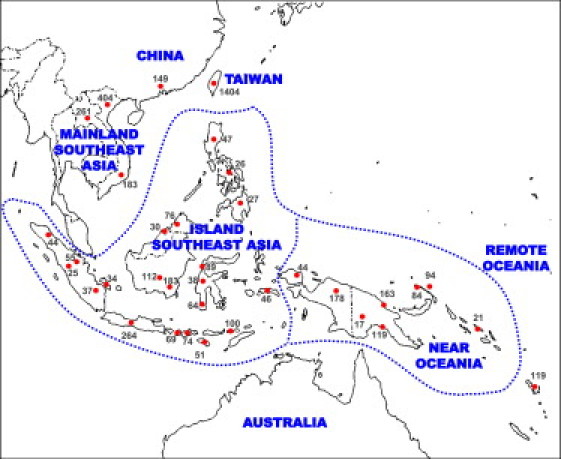
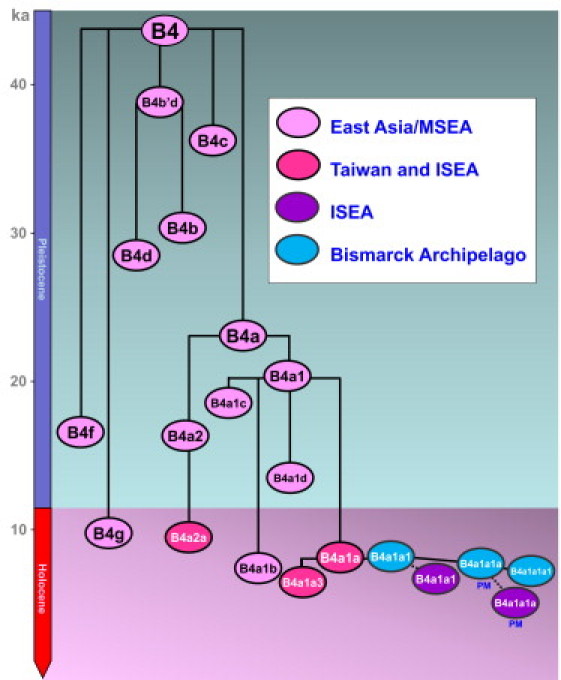
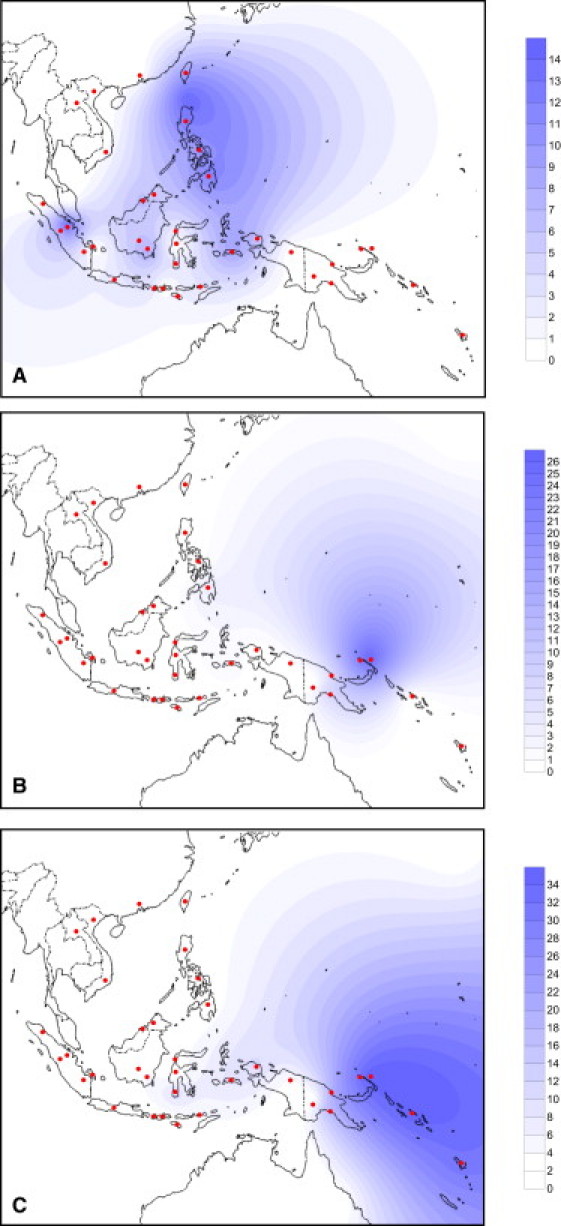
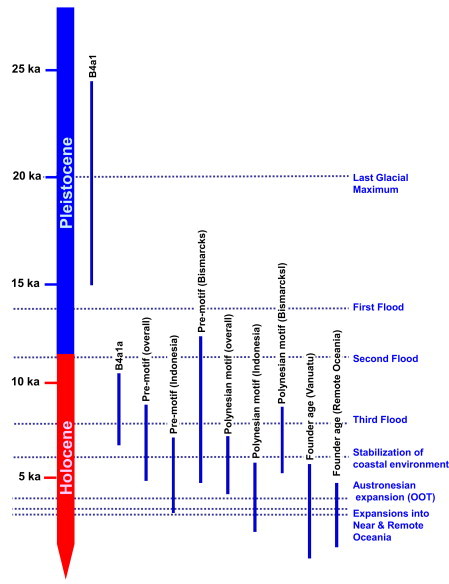
The "Polynesian motif" defines a lineage of human mtDNA that is restricted to Austronesian-speaking populations and is almost fixed in Polynesians. It is widely thought to support a rapid dispersal of maternal lineages from Taiwan ~4000 years ago (4 ka), but the chronological resolution of existing control-region data is poor, and an East Indonesian origin has also been proposed. By analyzing 157 complete mtDNA genomes, we show that the motif itself most likely originated >6 ka in the vicinity of the Bismarck Archipelago, and its immediate ancestor is >8 ka old and virtually restricted to Near Oceania. This indicates that Polynesian maternal lineages from Island Southeast Asia gained a foothold in Near Oceania much earlier than dispersal from either Taiwan or Indonesia 3-4 ka would predict. However, we find evidence in minor lineages for more recent two-way maternal gene flow between Island Southeast Asia and Near Oceania, likely reflecting movements along a "voyaging corridor" between them, as previously proposed on archaeological grounds. Small-scale mid-Holocene movements from Island Southeast Asia likely transmitted Austronesian languages to the long-established Southeast Asian colonies in the Bismarcks carrying the Polynesian motif, perhaps also providing the impetus for the expansion into Polynesia.
Copyright © 2011 The American Society of Human Genetics. Published by Elsevier Inc. All rights reserved.
Figures
References
-
- Bellwood P. Blackwell Publishing; Oxford: 2005. First Farmers: The Origins of Agricultural Societies.
-
- Spriggs M. The Neolithic and Austronesian expansion within Island Southeast Asia and into the Pacific. In: Chiu S., Sand C., editors. From Southeast Asia to the Pacific: Archaeological Perspectives on the Austronesian Expansion and the Lapita Cultural Complex. Academia Sinica; Taipei, Taiwan: 2007. pp. 104–140.
-
- Solheim W.G. University of Philippines Press; Quezon City, The Philippines: 2006. Archaeology and Culture in Southeast Asia: Unraveling the Nusantao.
-
- Terrell J.E. The ‘sleeping giant’ hypothesis and New Guinea's place in the prehistory of Greater Near Oceania. World Archaeol. 2004;36:601–609.
-
- Terrell J.E., Welsch R.L. Lapita and the temporal geography of prehistory. Antiquity. 1997;71:548–572.
Publication types
MeSH terms
Substances
Associated data
- Actions
- Actions
- Actions
- Actions
- Actions
- Actions
- Actions
- Actions
- Actions
- Actions
- Actions
- Actions
- Actions
- Actions
- Actions
- Actions
- Actions
- Actions
- Actions
- Actions
- Actions
- Actions
- Actions
- Actions
- Actions
- Actions
- Actions
- Actions
- Actions
- Actions
- Actions
- Actions
- Actions
- Actions
- Actions
- Actions
- Actions
- Actions
- Actions
- Actions
- Actions
- Actions
- Actions
- Actions
- Actions
- Actions
- Actions
- Actions
- Actions
- Actions
- Actions
- Actions
- Actions
- Actions
- Actions
- Actions
- Actions
- Actions
- Actions
- Actions
- Actions
- Actions
- Actions
- Actions
- Actions
- Actions
- Actions
- Actions
- Actions
- Actions
- Actions
- Actions
- Actions
- Actions
- Actions
- Actions
- Actions
- Actions
- Actions
- Actions
- Actions
LinkOut - more resources
Full Text Sources
