ViSHWaS: Violence Study of Healthcare Workers and Systems-a global survey
- PMID: 37696546
- PMCID: PMC10496720
- DOI: 10.1136/bmjgh-2023-013101
ViSHWaS: Violence Study of Healthcare Workers and Systems-a global survey
Abstract
Objective: To provide insights into the nature, risk factors, impact and existing measures for reporting and preventing violence in the healthcare system. The under-reporting of violence against healthcare workers (HCWs) globally highlights the need for increased public awareness and education.
Methods: The Violence Study of Healthcare Workers and Systems study used a survey questionnaire created using Research Electronic Data Capture (REDCap) forms and distributed from 6 June to 9 August 2022. Logistic regression analysis evaluated violence predictors, including gender, age, years of experience, institution type, respondent profession and night shift frequency. A χ2 test was performed to determine the association between gender and different violence forms.
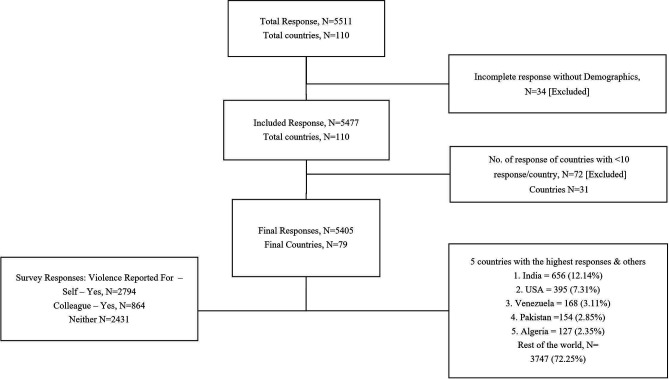
Results: A total of 5405 responses from 79 countries were analysed. India, the USA and Venezuela were the top three contributors. Female respondents comprised 53%. The majority (45%) fell within the 26-35 age group. Medical students (21%), consultants (20%), residents/fellows (15%) and nurses (10%) constituted highest responders. Nearly 55% HCWs reported firsthand violence experience, and 16% reported violence against their colleagues. Perpetrators were identified as patients or family members in over 50% of cases, while supervisor-incited violence accounted for 16%. Around 80% stated that violence incidence either remained constant or increased during the COVID-19 pandemic. Among HCWs who experienced violence, 55% felt less motivated or more dissatisfied with their jobs afterward, and 25% expressed willingness to quit. Univariate analysis revealed that HCWs aged 26-65 years, nurses, physicians, ancillary staff, those working in public settings, with >1 year of experience, and frequent night shift workers were at significantly higher risk of experiencing violence. These results remained significant in multivariate analysis, except for the 55-65 age group, which lost statistical significance.
Conclusion: This global cross-sectional study highlights that a majority of HCWs have experienced violence, and the incidence either increased or remained the same during the COVID-19 pandemic. This has resulted in decreased job satisfaction.
Keywords: community-based survey; cross-sectional survey; health education and promotion; prevention strategies; public health.
© Author(s) (or their employer(s)) 2023. Re-use permitted under CC BY-NC. No commercial re-use. See rights and permissions. Published by BMJ.
Conflict of interest statement
Competing interests: None declared.
Figures
References
-
- WHO . Framework guidelines for addressing workplace violence in the health sector / Joint Programme on Workplace Violence in the Health Sector. Geneva, 2002.
MeSH terms
LinkOut - more resources
Full Text Sources
Medical