


Disease Characteristics, Care-Seeking Behavior, and Outcomes Associated With the Use of AYUSH-64 in COVID-19 Patients in Home Isolation in India: A Community-Based Cross-Sectional Analysis
- PMID: 35900336
- PMCID: PMC9310753
- DOI: 10.3389/fpubh.2022.904279
Disease Characteristics, Care-Seeking Behavior, and Outcomes Associated With the Use of AYUSH-64 in COVID-19 Patients in Home Isolation in India: A Community-Based Cross-Sectional Analysis
Abstract
Background: During the second wave of the COVID-19 pandemic in India, the Ministry of Ayush conducted a community study to provide therapeutic care to patients with asymptomatic, mild, and moderate COVID-19 in home isolation based on the empirical evidence generated on the efficacy of AYUSH-64 in COVID-19.
Objective: To document disease characteristics, care-seeking behavior, and outcomes in patients with asymptomatic, mild, or moderate COVID-19 in home isolation who used AYUSH-64 for COVID-19.
Methods: Cross-sectional analysis of the data generated through a community study conducted in India from 08 May to 31 August 2021 was performed to study the disease characteristics, care-seeking behavior during home isolation, clinical outcomes, adverse events, and the association between various risk factors and clinical recovery during the study period. The data were collected through semi-structured questionnaires, available in electronic data collection format at the baseline, 7, 14, and 21 days. A logistic regression was performed to explore the relationship between relevant variables and clinical recovery.
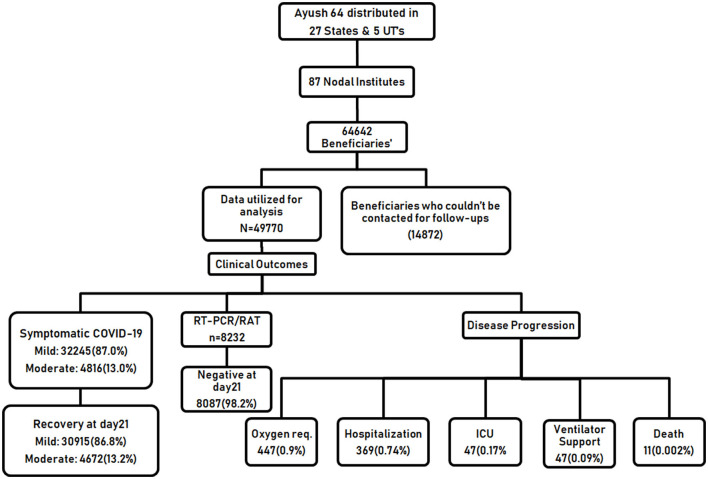
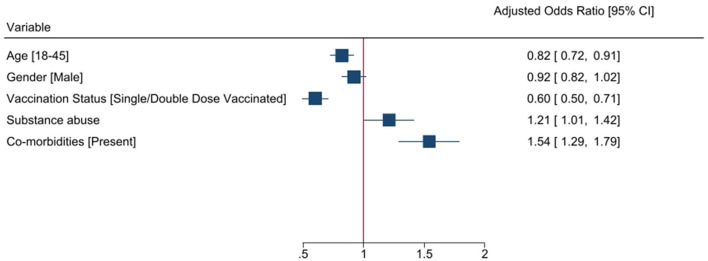
Results: Data from 64,642 participants were analyzed for baseline assessment, and final analysis was done for 49,770 participants. The mean age of the enrolled participants was 38.8 ± 11.7 years, and 8.4% had co-morbidities. AYUSH-64 was utilized as an add-on to the standard care by 58.3% of participants. Comparable clinical outcomes were observed in participants utilizing AYUSH-64 either as a standalone or as an add-on to standard care, in terms of clinical recovery, disease progression, the requirement for oxygen supplementation, hospitalization, ICU admission, and need for ventilator support. Younger age, having no co-morbidities or substance abuse, and having been vaccinated were associated with early clinical recovery than those who were older and not vaccinated.
Conclusions: The study findings suggest that AYUSH-64 use, either standalone or as an adjunct to standard care, in asymptomatic, mild, or moderate COVID-19 is associated with good clinical outcomes. Ayush services and interventions can be effectively integrated into the mainstream public health architecture to serve public health goals.
Keywords: AYUSH-64; Ayurveda; Ayush; COVID-19; community study; home isolation.
Copyright © 2022 Srikanth, Kumar, Chandrasekhararao, Singhal, Yadav, Khanduri, Jameela, Rai, Tripathi, Rana, Ahmad, Sharma, Jaiswal, Kotecha and State Level Collaborators.
Conflict of interest statement
The authors declare that the research was conducted in the absence of any commercial or financial relationships that could be construed as a potential conflict of interest.
Figures
References
-
- Organisation for Economic Co-operation Development. OECD Policy Responses to Coronavirus (COVID-19). Youth and COVID-19: Response, Recovery, and Resilience (2020). Available online at: https://www.oecd.org/coronavirus/policy-responses/youth-and-covid-19-res... (accessed November 08, 2021).
-
- Ministry Ministry of Ayush Government Government of India. National Clinical Management Protocol Based on Ayurveda and Yoga for Management of Covid-19 (2020). Available online at: https://www.ayush.gov.in/docs/ayush-Protocol-covid-19.pdf. (accessed December 17, 2021).
Publication types
MeSH terms
Substances
LinkOut - more resources
Full Text Sources
Medical
