


Geographical parthenogenesis and population genetic structure in the alpine species Ranunculus kuepferi (Ranunculaceae)
- PMID: 23403961
- PMCID: PMC3656632
- DOI: 10.1038/hdy.2013.1
Geographical parthenogenesis and population genetic structure in the alpine species Ranunculus kuepferi (Ranunculaceae)
Abstract
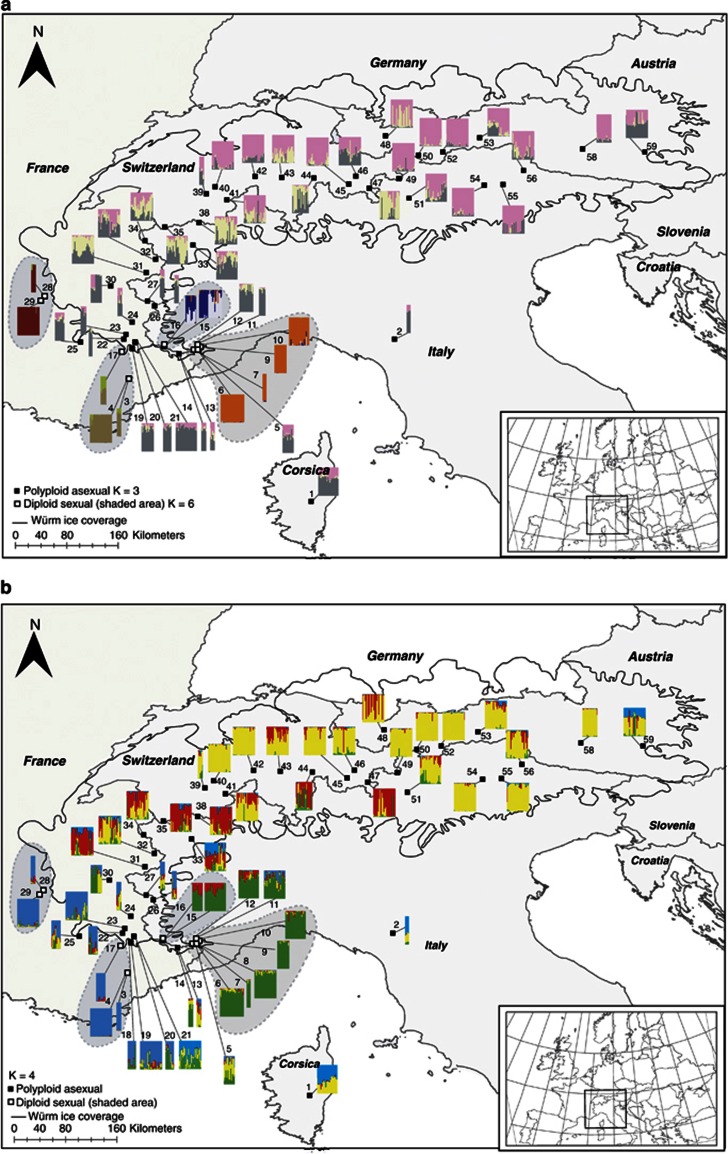
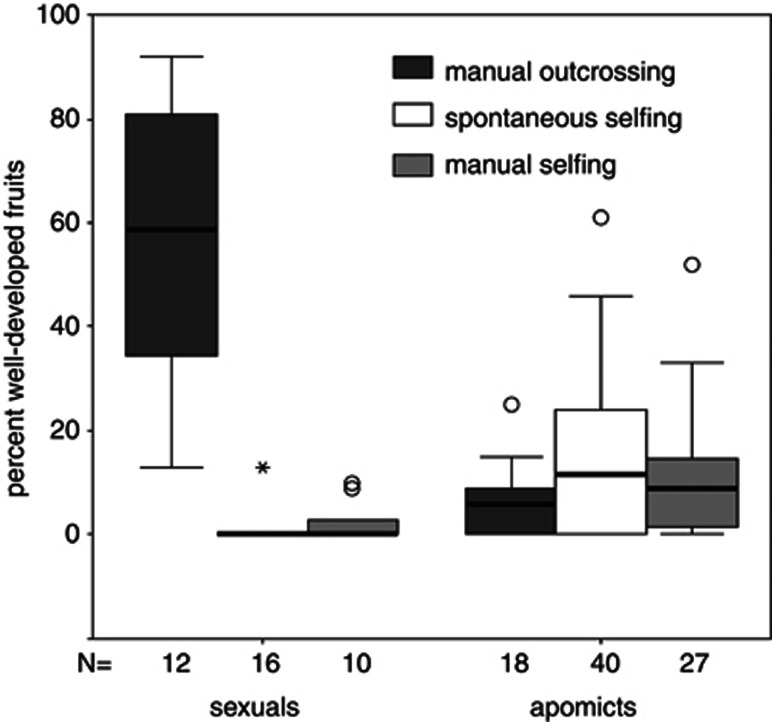
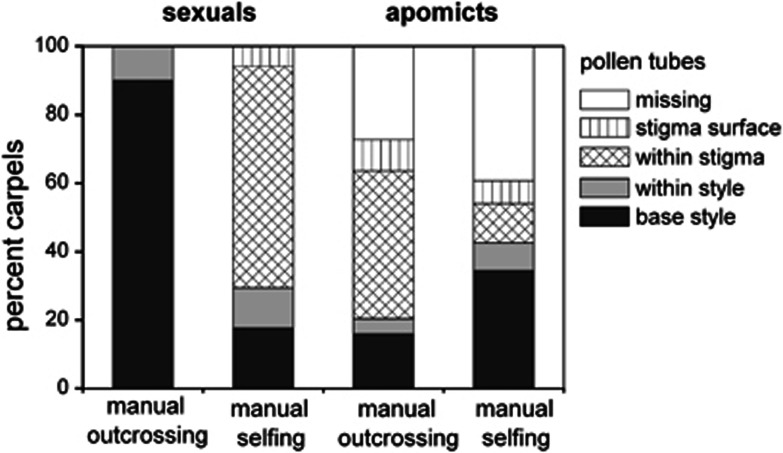
Geographical parthenogenesis describes the enigmatic phenomenon that asexual organisms have larger distribution areas than their sexual relatives, especially in previously glaciated areas. Classical models suggest temporary advantages to asexuality in colonization scenarios because of uniparental reproduction and clonality. We analyzed population genetic structure and self-fertility of the plant species Ranunculus kuepferi on 59 populations from the whole distribution area (European Alps, Apennines and Corsica). Amplified fragment length polymorphisms (AFLPs) and five microsatellite loci revealed individual genotypes for all populations and mostly insignificant differences between diploid sexuals and tetraploid apomicts in all measures of genetic diversity. Low frequencies of private AFLP fragments/simple sequence repeat alleles, and character incompatibility analyses suggest that facultative recombination explains best the unexpectedly high genotypic diversity of apomicts. STRUCTURE analyses using AFLPs revealed a higher number of partitions and a stronger geographical subdivision for diploids than for tetraploids, which contradicts expectations of standard gene flow models, but indicates a reduction of genetic structure in asexuals. Apomictic populations exhibited high admixture near the sexual area, but appeared rather uniform in remote areas. Bagging experiments and analyses of pollen tube growth confirmed self-fertility for pollen-dependent apomicts, but self-sterility for diploid sexuals. Facultative apomixis combines advantages of both modes of reproduction: uniparental reproduction allows for rapid colonization of remote areas, whereas facultative sexuality and polyploidy maintains genetic diversity within apomictic populations. The density dependence of outcrossing limits range expansions of sexual populations.
Figures
References
-
- Arnaud-Haond S, Duarte CM, Albero F, Serrao EA. Standardizing methods to address clonality in population studies. Mol Ecol. 2007;16:5115–5139. - PubMed
-
- Baker HG.1965Characteristics and modes of origin of weedsIn: Baker HG, Stebbins GL, (eds).The Genetics of Colonizing Species Academic Press: New York; 147–168.
-
- Baker HG. Support for Baker's Law-as a rule. Evolution. 1967;21:853–856. - PubMed
-
- Bell G. The Masterpiece of Nature: the Evolution and Genetics of Sexuality. Croom Helm: London; 1982.
-
- Bierzychudek P. Patterns in plant parthenogenesis. Experientia. 1985;41:1255–1264. - PubMed
MeSH terms
Associated data
- Actions
- Actions
Grants and funding
LinkOut - more resources
Full Text Sources
Other Literature Sources
