. 2013 Apr 12;8(4):e60605.
doi: 10.1371/journal.pone.0060605. Print 2013.

Human-specific HERV-K insertion causes genomic variations in the human genome

Affiliations

Human-specific HERV-K insertion causes genomic variations in the human genome

Wonseok Shin et al. PLoS One. .

Abstract

Human endogenous retroviruses (HERV) sequences account for about 8% of the human genome. Through comparative genomics and literature mining, we identified a total of 29 human-specific HERV-K insertions. We characterized them focusing on their structure and flanking sequence. The results showed that four of the human-specific HERV-K insertions deleted human genomic sequences via non-classical insertion mechanisms. Interestingly, two of the human-specific HERV-K insertion loci contained two HERV-K internals and three LTR elements, a pattern which could be explained by LTR-LTR ectopic recombination or template switching. In addition, we conducted a polymorphic test and observed that twelve out of the 29 elements are polymorphic in the human population. In conclusion, human-specific HERV-K elements have inserted into human genome since the divergence of human and chimpanzee, causing human genomic changes. Thus, we believe that human-specific HERV-K activity has contributed to the genomic divergence between humans and chimpanzees, as well as within the human population.


Conflict of interest statement

Competing Interests: The authors have declared that no competing interests exist.

Figures

Figure 1
Figure 1. Comparison of human-specific HERV-K108 and HERV-K124 elements.
Both of HERV-K108 and HERV-K124 have two HERV-K internal regions (green). However, their sequence architecture is the result of different mechanisms. (A) HERV-K108. After the insertion of the HERV-K element, non-allelic homologous recombination between two different LTRs (yellow chevrons) of the HERV-K element occurred. This resulted in a locus containing two HERV-K internal regions and three LTRs. This locus retains the original TSDs (red chevrons) created upon its initial insertion. (B) HERV-K124. Compared to the HERV-K108, which has two intact internal regions and three intact LTRs, the second internal region of HERV-K124 has largely deleted and its internal and 3′ LTRs inverted and partially deleted. The mechanism(s) responsible for this element’s sequence architecture is not clearly resolved, but we depict here a potential mechanism capable of generating this element. Yellow boxes indicate standard LTRs, pink boxes indicate inverted partial LTRs, and green boxes indicate HERV-K internal regions.
Figure 2
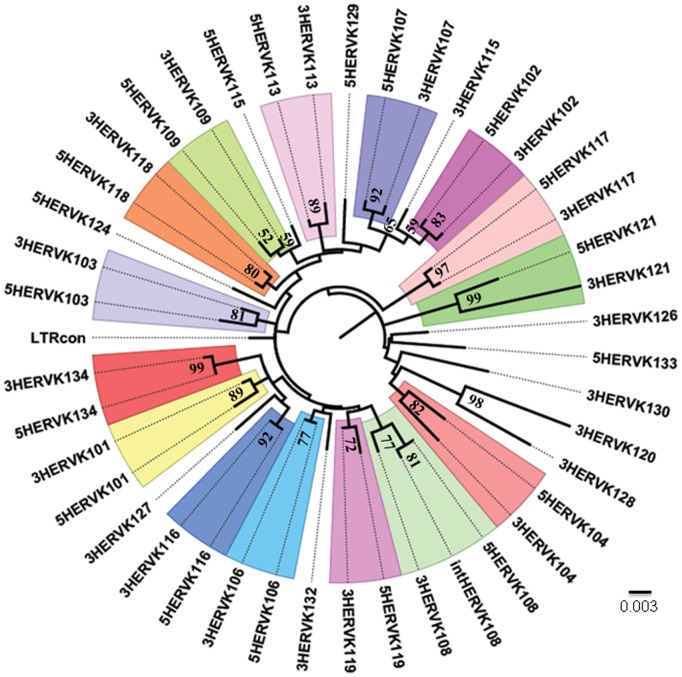
Figure 2. The phylogenetic tree of human-specific HERV-K LTRs.
This is a maximum likelihood tree reconstructed using Kimura-2-parameter distance model. Most HERV-K elements contain an LTR at their 5′ and 3′ ends. In cases where the two LTR sequences are similar to one another, they are shown in the same colour. LTRs from the same element but having divergent sequences are not clustered in the same colour. Short LTRs causing ambiguity on this tree were excluded from this analysis. Bootstrap values for nodes (% of 1000 replicates) scoring higher than 50% are reported.
Figure 3
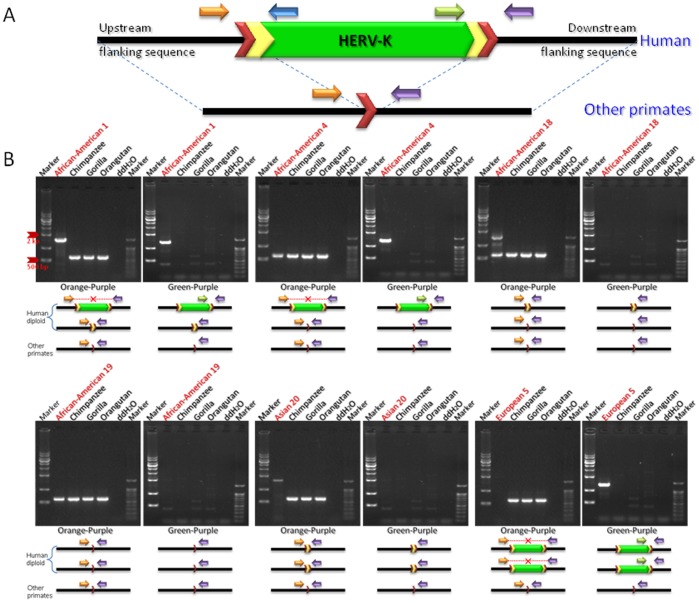
Figure 3. Variable polymorphic patterns of a HERV-K118 in human diploid genomes.
Human-specific HERV-K118 insertion locus was amplified by PCR using the genomic DNAs of human population and other primates as template. (A) A typical primate HERV-K element. The ∼7.5 kb structure of the HERV-K internal region is shown in green. Yellow chevrons are LTRs (∼1 kb) and red chevrons are target site duplications (TSDs). (B) Gel chromatographs show PCR products of targeted human-specific HERV-K loci on a panel containing human three non-human primates. High bands indicate the presence of an insertion, while low bands indicate its absence. Orange and purple arrows indicate primers designed in the conserved flanking regions of all species. Green arrows indicate internal primers designed within the human-specific HERV-K. As shown in the gel pictures, human-specific HERV-K insertion loci exhibit a variety polymorphic patterns in human diploid genomes.
Figure 4
Figure 4. Diagram of a human-specific full-length HERV-K element.
The ORFs of gag, pro, pol, and env are depicted as colored boxes. HERV-K members that contain versions of gag, pro, pol, and env are listed under each HERV genes (* and # indicate that the HERV-K locus contains stop codon or broken frame, respectively).
Figure 5
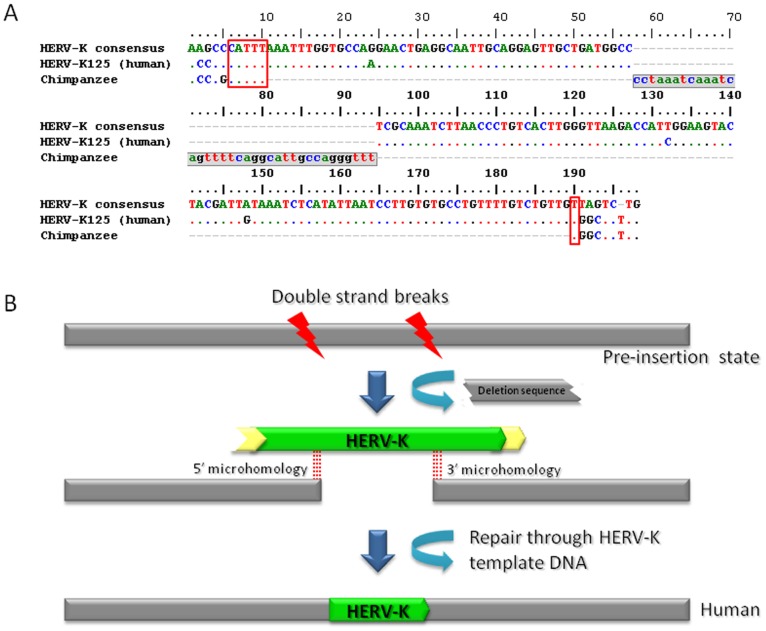
Figure 5. Non-classical insertion of human-specific HERV-K element in the human genome.
Four non-classical insertions of human-specific HERV-K were observed in the human genome. The human-specific locus, HERV-K125, is depicted here. (A) An alignment of the non-classical insertion of human-specific HERV-K125 element, and its pre-insertion site to the HERV-K consensus sequence. This alignment reveals a 37 bp deletion of the pre-insertion site in the human genome (gray region in the chimpanzee sequence). Red boxes indicate microhomology at either end of the non-classical insertion, which suggests the involvement of an NHEJ mechanism. (B) A schematic diagram that describes the non-classical insertion of an HERV-K element (green box) and the deleted-region of genomic sequence (broken gray box).

References

    1. Lander ES, Linton LM, Birren B, Nusbaum C, Zody MC, et al. (2001) Initial sequencing and analysis of the human genome. Nature 409: 860–921. - PubMed
    1. Barbulescu M, Turner G, Seaman MI, Deinard AS, Kidd KK, et al. (1999) Many human endogenous retrovirus K (HERV-K) proviruses are unique to humans. Curr Biol 9: 861–868. - PubMed
    1. Griffiths DJ (2001) Endogenous retroviruses in the human genome sequence. Genome Biol 2: REVIEWS1017. - PMC - PubMed
    1. Khodosevich K, Lebedev Y, Sverdlov E (2002) Endogenous retroviruses and human evolution. Comp Funct Genomics 3: 494–498. - PMC - PubMed
    1. Balada E, Ordi-Ros J, Vilardell-Tarres M (2009) Molecular mechanisms mediated by human endogenous retroviruses (HERVs) in autoimmunity. Rev Med Virol 19: 273–286. - PubMed

Publication types