


Hunting for the LCT-13910*T allele between the Middle Neolithic and the Middle Ages suggests its absence in dairying LBK people entering the Kuyavia region in the 8th millennium BP
- PMID: 25853887
- PMCID: PMC4390234
- DOI: 10.1371/journal.pone.0122384
Hunting for the LCT-13910*T allele between the Middle Neolithic and the Middle Ages suggests its absence in dairying LBK people entering the Kuyavia region in the 8th millennium BP
Abstract
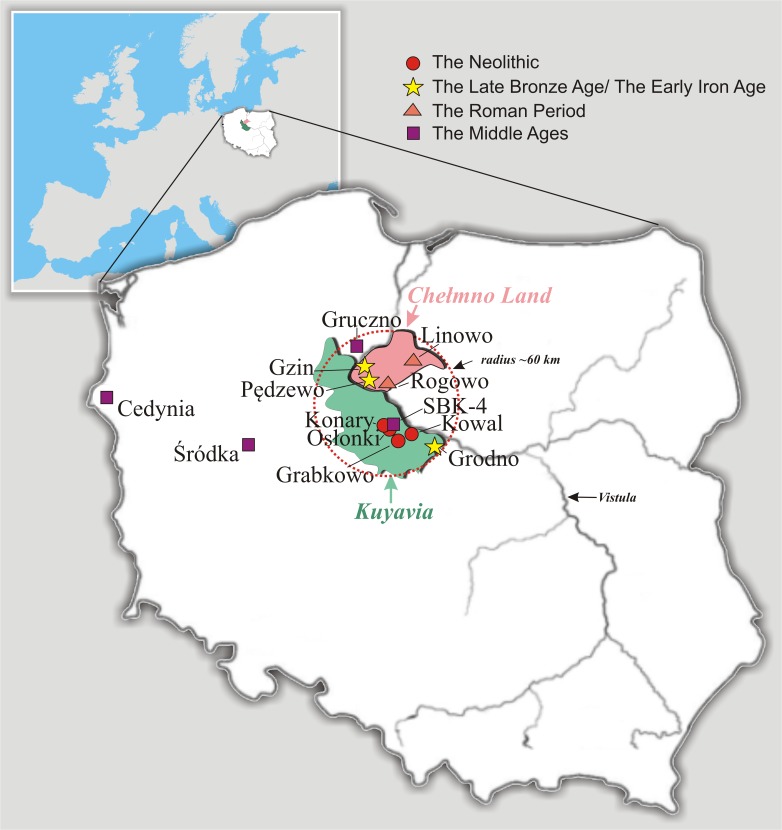
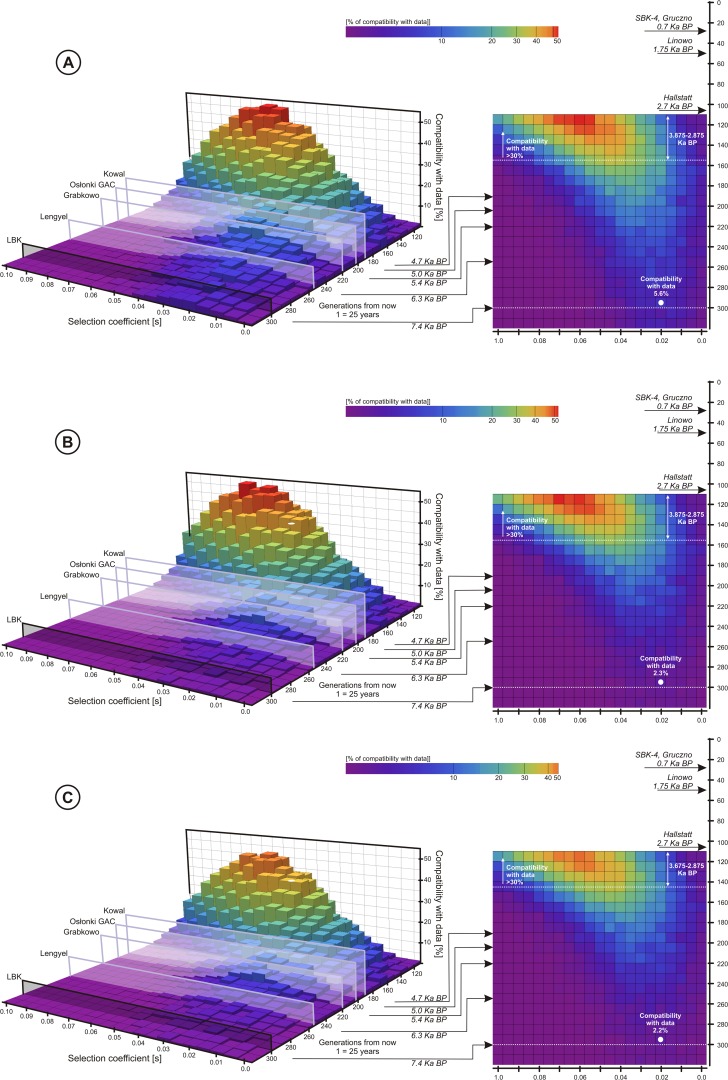
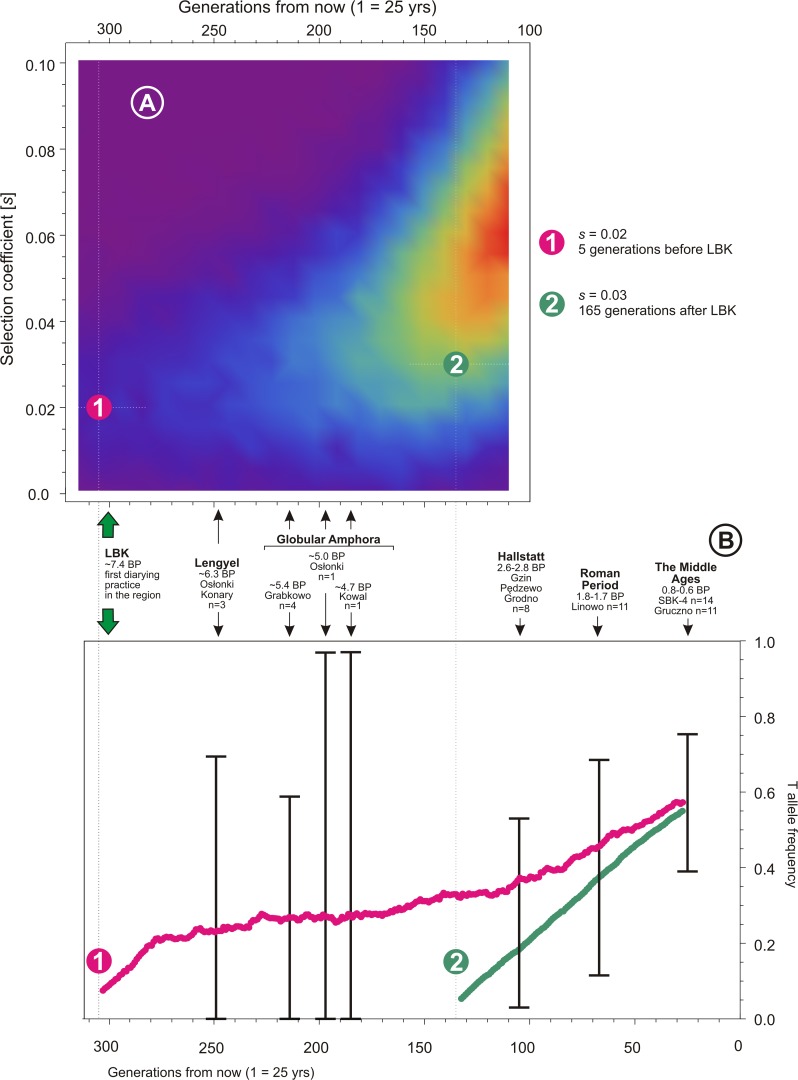
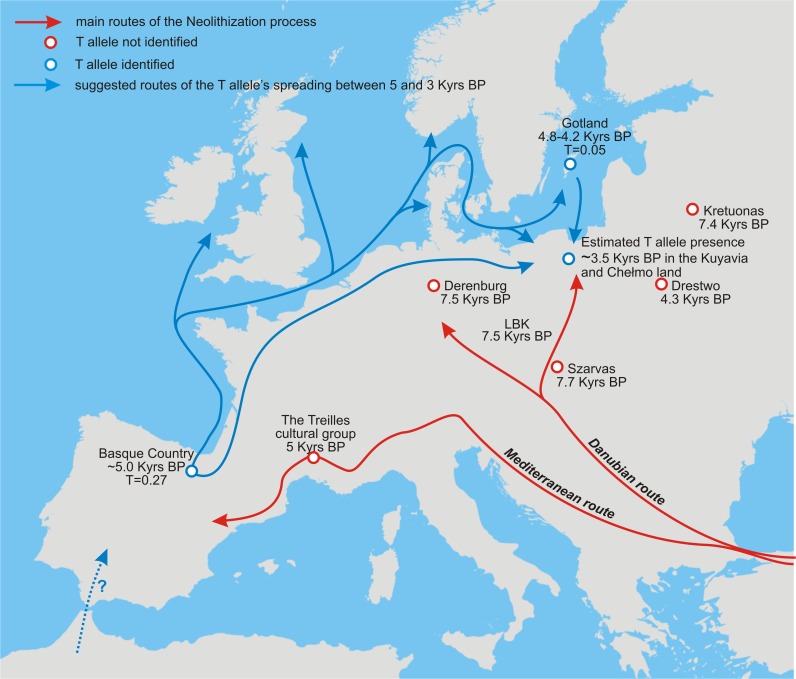
Populations from two medieval sites in Central Poland, Stary Brześć Kujawski-4 (SBK-4) and Gruczno, represented high level of lactase persistence (LP) as followed by the LCT-13910*T allele's presence (0.86 and 0.82, respectively). It was twice as high as in contemporaneous Cedynia (0.4) and Śródka (0.43), both located outside the region, higher than in modern inhabitants of Poland (0.51) and almost as high as in modern Swedish population (0.9). In an attempt to explain the observed differences its frequency changes in time were followed between the Middle Neolithic and the Late Middle Ages in successive dairying populations on a relatively small area (radius ∼60km) containing the two sites. The introduction of the T allele to Kuyavia 7.4 Ka BP by dairying LBK people is not likely, as suggested by the obtained data. It has not been found in any of Neolithic samples dated between 6.3 and 4.5 Ka BP. The identified frequency profile indicates that both the introduction and the beginning of selection could have taken place approx. 4 millennia after first LBK people arrived in the region, shifting the value of LP frequency from 0 to more than 0.8 during less than 130 generations. We hypothesize that the selection process of the T allele was rather rapid, starting just after its introduction into already milking populations and operated via high rates of fertility and mortality on children after weaning through life-threatening conditions, favoring lactose-tolerant individuals. Facing the lack of the T allele in people living on two great European Neolithization routes, the Danubian and Mediterranean ones, and based on its high frequency in northern Iberia, its presence in Scandinavia and estimated occurrence in Central Poland, we propose an alternative Northern Route of its spreading as very likely. None of the successfully identified nuclear alleles turned out to be deltaF508 CFTR.
Conflict of interest statement
Figures
References
-
- Enattah NS, Sahi T, Savilahti E, Terwilliger JD, Peltonen L, Jarvela L (2002) Identification of a variant associated with adult-type hypolactasia. Nat Genet 30: 233–237. - PubMed
-
- Enattah NS, Jensen TG, Nielsen M, Lewinski R, Kuokkanen M, Rasinpera H, et al. (2008) Independent introduction of two lactase-persistence alleles into human populations reflects different history of adaptation to milk culture. Am J Hum Genet 82: 57–72. 10.1016/j.ajhg.2007.09.012 - DOI - PMC - PubMed
Publication types
MeSH terms
Substances
Associated data
- Actions
- Actions
- Actions
- Actions
- Actions
- Actions
- Actions
- Actions
- Actions
- Actions
- Actions
- Actions
- Actions
- Actions
- Actions
- Actions
- Actions
- Actions
- Actions
- Actions
- Actions
- Actions
- Actions
- Actions
- Actions
- Actions
- Actions
- Actions
- Actions
- Actions
- Actions
- Actions
- Actions
- Actions
- Actions
- Actions
- Actions
- Actions
- Actions
- Actions
- Actions
- Actions
- Actions
- Actions
- Actions
- Actions
- Actions
- Actions
- Actions
- Actions
- Actions
- Actions
- Actions
- Actions
- Actions
- Actions
- Actions
- Actions
- Actions
- Actions
- Actions
- Actions
- Actions
- Actions
- Actions
- Actions
- Actions
- Actions
- Actions
- Actions
- Actions
- Actions
- Actions
- Actions
- Actions
- Actions
- Actions
- Actions
- Actions
- Actions
- Actions
- Actions
- Actions
- Actions
- Actions
- Actions
- Actions
- Actions
- Actions
- Actions
- Actions
- Actions
- Actions
- Actions
- Actions
- Actions
- Actions
- Actions
- Actions
- Actions
- Actions
- Actions
- Actions
- Actions
- Actions
- Actions
- Actions
- Actions
- Actions
- Actions
- Actions
- Actions
- Actions
- Actions
- Actions
- Actions
- Actions
- Actions
- Actions
- Actions
- Actions
- Actions
- Actions
- Actions
- Actions
- Actions
- Actions
- Actions
- Actions
- Actions
- Actions
LinkOut - more resources
Full Text Sources
Other Literature Sources
Medical
Research Materials
