


The effect of Helicobacter pylori infection and eradication in patients with gastro-oesophageal reflux disease: A parallel-group, double-blind, placebo-controlled multicentre study
- PMID: 24917966
- PMCID: PMC4040789
- DOI: 10.1177/2050640613484020
The effect of Helicobacter pylori infection and eradication in patients with gastro-oesophageal reflux disease: A parallel-group, double-blind, placebo-controlled multicentre study
Abstract
Objectives: This study aimed to resolve controversy regarding the effects of Helicobacter pylori eradication therapy and H. pylori infection in gastro-oesophageal reflux disease.
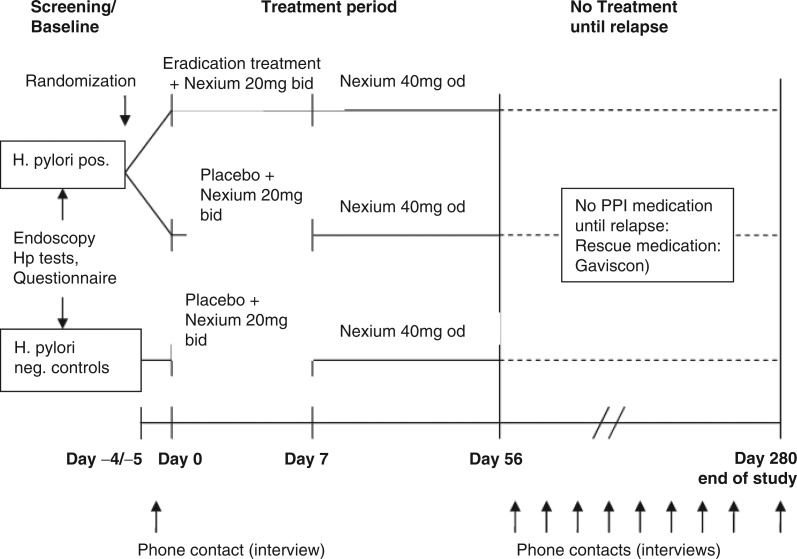
Design: A randomized, double-blind, multicentre trial was performed in patients presenting with reflux symptoms. H. pylori-positive patients were randomized to receive either antibiotics or placebo for 7 days. H. pylori-negative patient controls received placebo. All received esomeprazole 20 mg b.d. for 7 days, followed by 40 mg o.d. to complete an 8-week course, and were followed up for 32 weeks by telephone.
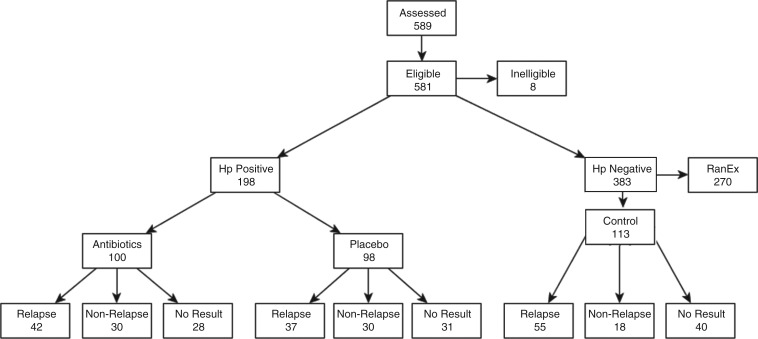
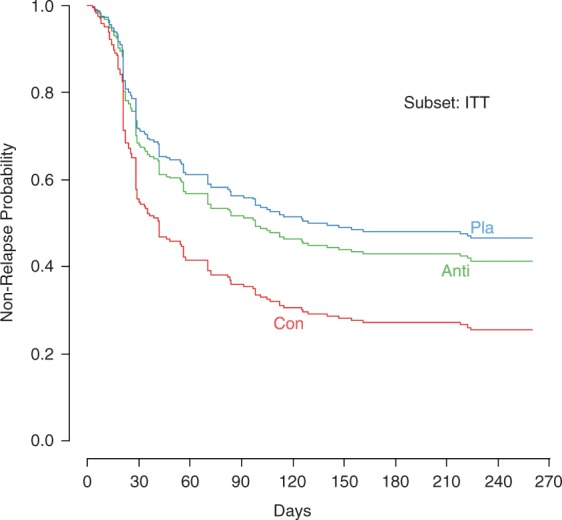
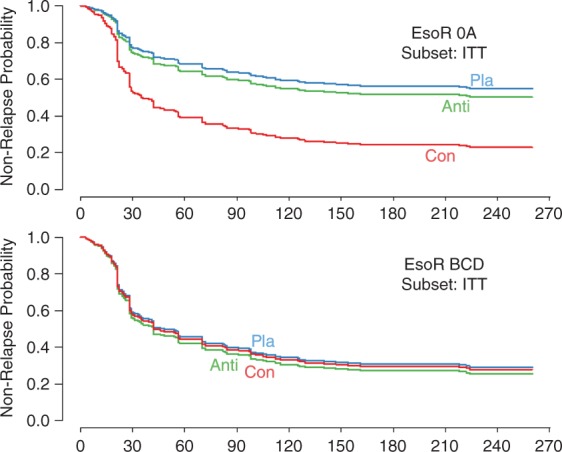
Results: In this study, 198/589 (34%) patients were H. pylori-positive and 113 H. pylori-negative patients served as controls. Baseline endoscopy revealed 63% Los Angeles grade 0A and 37% Los Angeles grade BCD oesophagitis with no difference between patient groups. Symptom improvement on esomeprazole was seen in 89%. H. pylori eradication was successful in 82%. H. pylori eradication had no effect on symptomatic relapse (hazard ratio 1.15, 95% CI 0.74-1.8; p = 0.5). Overall, H. pylori-positive patients had a lower probability of relapse compared to H. pylori-negative controls (hazard ratio 0.6, 95% CI 0.43-0.85; p = 0.004). Relapse hazard was modulated also by oesophagitis grade (BCD vs. 0A, hazard ratio 2.1, 95% CI 1.5-3.0).
Conclusion: Relapse of gastro-oesophageal reflux disease symptoms after a course of high dose acid suppression took longer for H. pylori-positive patients than H. pylori-negative controls; however eradication therapy had no effect on the risk of relapse; ClincialTrials.gov number, NCT00574925.
Keywords: H. pylori eradication therapy; Helicobacter pylori; esomeprazole; gastritis; gastro-oesophageal reflux disease; oesophagitis; symptomatic relapse.
Figures
References
-
- Lagergren J, Bergstrom R, Lindgren A, et al. Symptomatic gastroesophageal reflux as a risk factor for esophageal adenocarcinoma. N Engl J Med 1999; 340: 825–831 - PubMed
-
- Kuipers EJ, Uyterlinde AM, Pena AS, et al. Increase of Helicobacter pylori-associated corpus gastritis during acid suppressive therapy: implications for long-term safety. Am J Gastroenterol 1995; 90: 1401–1406 - PubMed
-
- Richter JE, Kahrilas PJ, Johanson J, et al. Efficacy and safety of esomeprazole compared with omeprazole in GERD patients with erosive esophagitis: a randomized controlled trial. Am J Gastroenterol 2001; 96: 656–965 - PubMed
-
- Graham KS, Graham DY. Helicobacter pylori, gastroesophageal reflux disease, Barrett's esophagus, and adenocarcinoma of the distal esophagus. In: Contemporary diagnosis and management of Helicobacter pylori-associated gastrointestinal diseases, 2nd ed Newtown: Pennsylvania, 2002; 128–147
Associated data
LinkOut - more resources
Full Text Sources
Other Literature Sources
Medical
