Pharmacodynamic characteristics of lixisenatide once daily versus liraglutide once daily in patients with type 2 diabetes insufficiently controlled on metformin
- PMID: 23368510
- PMCID: PMC3752965
- DOI: 10.1111/dom.12076
Pharmacodynamic characteristics of lixisenatide once daily versus liraglutide once daily in patients with type 2 diabetes insufficiently controlled on metformin
Abstract
Aim: Assess the pharmacodynamics of lixisenatide once daily (QD) versus liraglutide QD in type 2 diabetes insufficiently controlled on metformin.
Methods: In this 28-day, randomized, open-label, parallel-group, multicentre study (NCT01175473), patients (mean HbA1c 7.3%) received subcutaneous lixisenatide QD (10 µg weeks 1-2, then 20 µg; n = 77) or liraglutide QD (0.6 mg week 1, 1.2 mg week 2, then 1.8 mg; n = 71) 30 min before breakfast. Primary endpoint was change in postprandial plasma glucose (PPG) exposure from baseline to day 28 during a breakfast test meal.
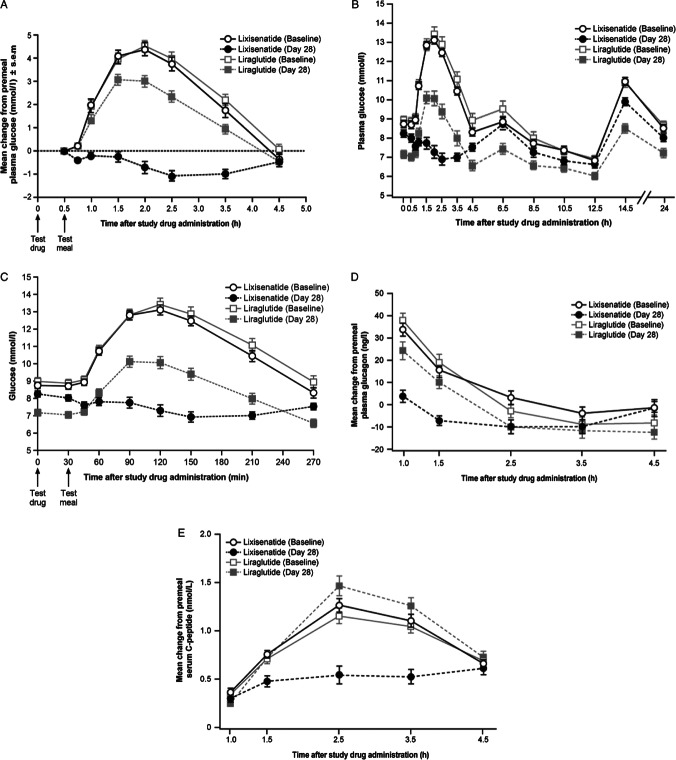
Results: Lixisenatide reduced PPG significantly more than liraglutide [mean change in AUC(0:30-4:30h) : -12.6 vs. -4.0 h·mmol/L, respectively; p < 0.0001 (0:30 h = start of meal)]. Change in maximum PPG excursion was -3.9 mmol/l vs. -1.4 mmol/l, respectively (p < 0.0001). More lixisenatide-treated patients achieved 2-h PPG <7.8 mmol/l (69% vs. 29%). Changes in fasting plasma glucose were greater with liraglutide (-0.3 vs. -1.3 mmol/l, p < 0.0001). Lixisenatide provided greater decreases in postprandial glucagon (p < 0.05), insulin (p < 0.0001) and C-peptide (p < 0.0001). Mean HbA1c decreased in both treatment groups (from 7.2% to 6.9% with lixisenatide vs. 7.4% to 6.9% with liraglutide) as did body weight (-1.6 kg vs. -2.4 kg, respectively). Overall incidence of adverse events was lower with lixisenatide (55%) versus liraglutide (65%), with no serious events or hypoglycaemia reported.
Conclusions: Once daily prebreakfast lixisenatide provided a significantly greater reduction in PPG (AUC) during a morning test meal versus prebreakfast liraglutide. Lixisenatide provided significant decreases in postprandial insulin, C-peptide (vs. an increase with liraglutide) and glucagon, and better gastrointestinal tolerability than liraglutide.
© 2013 Blackwell Publishing Ltd.
Figures
References
-
- Monnier L, Colette C, Dunseath GJ, Owens DR. The loss of postprandial glycemic control precedes stepwise deterioration of fasting with worsening diabetes. Diabetes Care. 2007;30:263–269. - PubMed
-
- Monnier L, Lapinski H, Colette C. Contributions of fasting and postprandial plasma glucose increments to the overall diurnal hyperglycemia of type 2 diabetic patients: variations with increasing levels of HbA(1c) Diabetes Care. 2003;26:881–885. - PubMed
-
- Peter R, Dunseath G, Luzio SD, Chudleigh R, Choudhury SR, Owens DR. Relative and absolute contributions of postprandial and fasting plasma glucose to daytime hyperglycaemia and HbA(1c) in subjects with type 2 diabetes. Diabet Med. 2009;26:974–980. - PubMed
-
- Woerle HJ, Neumann C, Zschau S, et al. Impact of fasting and postprandial glycemia on overall glycemic control in type 2 diabetes: importance of postprandial glycemia to achieve target HbA1c levels. Diabetes Res Clin Pract. 2007;77:280–285. - PubMed
Publication types
MeSH terms
Substances
Associated data
LinkOut - more resources
Full Text Sources
Other Literature Sources
Medical