


Ranolazine in Symptomatic Diabetic Patients Without Obstructive Coronary Artery Disease: Impact on Microvascular and Diastolic Function
- PMID: 28473401
- PMCID: PMC5524071
- DOI: 10.1161/JAHA.116.005027
Ranolazine in Symptomatic Diabetic Patients Without Obstructive Coronary Artery Disease: Impact on Microvascular and Diastolic Function
Abstract
Background: Treatments for patients with myocardial ischemia in the absence of angiographic obstructive coronary artery disease are limited. In these patients, particularly those with diabetes mellitus, diffuse coronary atherosclerosis and microvascular dysfunction is a common phenotype and may be accompanied by diastolic dysfunction. Our primary aim was to determine whether ranolazine would quantitatively improve exercise-stimulated myocardial blood flow and cardiac function in symptomatic diabetic patients without obstructive coronary artery disease.
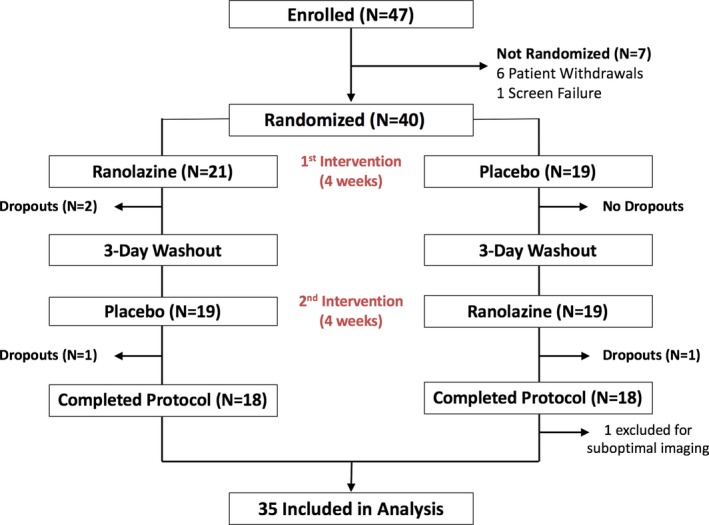
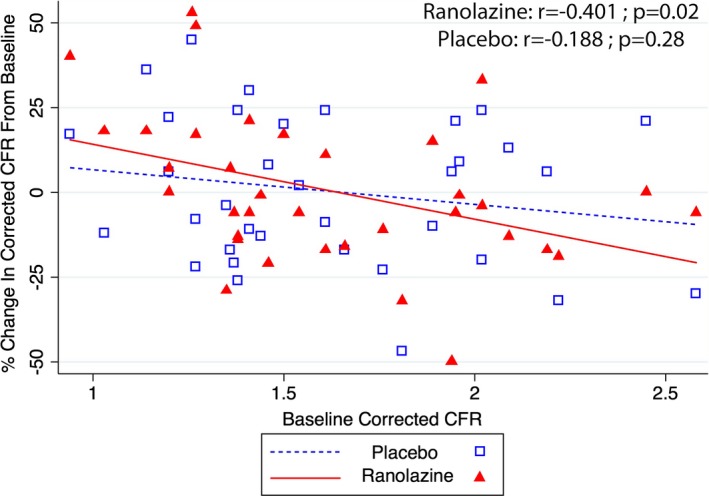
Methods and results: We conducted a double-blinded crossover trial with 1:1 random allocation to the order of ranolazine and placebo. At baseline and after each 4-week treatment arm, left ventricular myocardial blood flow and coronary flow reserve (CFR; primary end point) were measured at rest and after supine bicycle exercise using 13N-ammonia myocardial perfusion positron emission tomography. Resting echocardiography was also performed. Multilevel mixed-effects linear regression was used to determine treatment effects. Thirty-five patients met criteria for inclusion. Ranolazine did not significantly alter rest or postexercise left ventricular myocardial blood flow or CFR. However, patients with lower baseline CFR were more likely to experience improvement in CFR with ranolazine (r=-0.401, P=0.02) than with placebo (r=-0.188, P=0.28). In addition, ranolazine was associated with an improvement in E/septal e' (P=0.001) and E/lateral e' (P=0.01).
Conclusions: In symptomatic diabetic patients without obstructive coronary artery disease, ranolazine did not change exercise-stimulated myocardial blood flow or CFR but did modestly improve diastolic function. Patients with more severe baseline impairment in CFR may derive more benefit from ranolazine.
Clinical trial registration: URL: http://www.clinicaltrials.gov. Unique identifier: NCT01754259.
Keywords: diabetes mellitus; microvascular dysfunction; positron emission tomography; randomized controlled trial; ranolazine.
© 2017 The Authors. Published on behalf of the American Heart Association, Inc., by Wiley.
Figures
References
-
- Ong P, Athanasiadis A, Borgulya G, Mahrholdt H, Kaski JC, Sechtem U. High prevalence of a pathological response to acetylcholine testing in patients with stable angina pectoris and unobstructed coronary arteries. The ACOVA Study (abnormal coronary vasomotion in patients with stable angina and unobstructed coronary arteries). J Am Coll Cardiol. 2012;59:655–662. - PubMed
-
- Shaw LJ, Bairey Merz CN, Pepine CJ, Reis SE, Bittner V, Kelsey SF, Olson M, Johnson BD, Mankad S, Sharaf BL, Rogers WJ, Wessel TR, Arant CB, Pohost GM, Lerman A, Quyyumi AA, Sopko G; Investigators W . Insights from the NHLBI‐sponsored women's ischemia syndrome evaluation (WISE) study: Part I: gender differences in traditional and novel risk factors, symptom evaluation, and gender‐optimized diagnostic strategies. J Am Coll Cardiol. 2006;47:S4–S20. - PubMed
-
- Jespersen L, Hvelplund A, Abildstrom SZ, Pedersen F, Galatius S, Madsen JK, Jorgensen E, Kelbaek H, Prescott E. Stable angina pectoris with no obstructive coronary artery disease is associated with increased risks of Major Adverse Cardiovascular Events. Eur Heart J. 2012;33:734–744. - PubMed
-
- Jespersen L, Abildstrom SZ, Hvelplund A, Galatius S, Madsen JK, Pedersen F, Hojberg S, Prescott E. Symptoms of angina pectoris increase the probability of disability pension and premature exit from the workforce even in the absence of obstructive coronary artery disease. Eur Heart J. 2013;34:3294–3303. - PubMed
-
- Paulus WJ, Tschope C. A novel paradigm for heart failure with preserved ejection fraction: comorbidities drive myocardial dysfunction and remodeling through coronary microvascular endothelial inflammation. J Am Coll Cardiol. 2013;62:263–271. - PubMed
Publication types
MeSH terms
Substances
Associated data
Grants and funding
LinkOut - more resources
Full Text Sources
Other Literature Sources
Medical
Miscellaneous
