


A phase 1/2 ascending dose study and open-label extension study of voxelotor in patients with sickle cell disease
- PMID: 30655275
- PMCID: PMC6484388
- DOI: 10.1182/blood-2018-08-868893
A phase 1/2 ascending dose study and open-label extension study of voxelotor in patients with sickle cell disease
Abstract
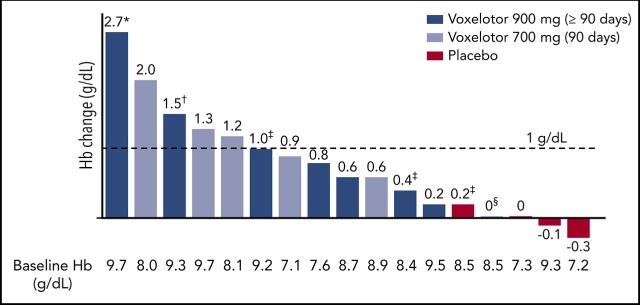
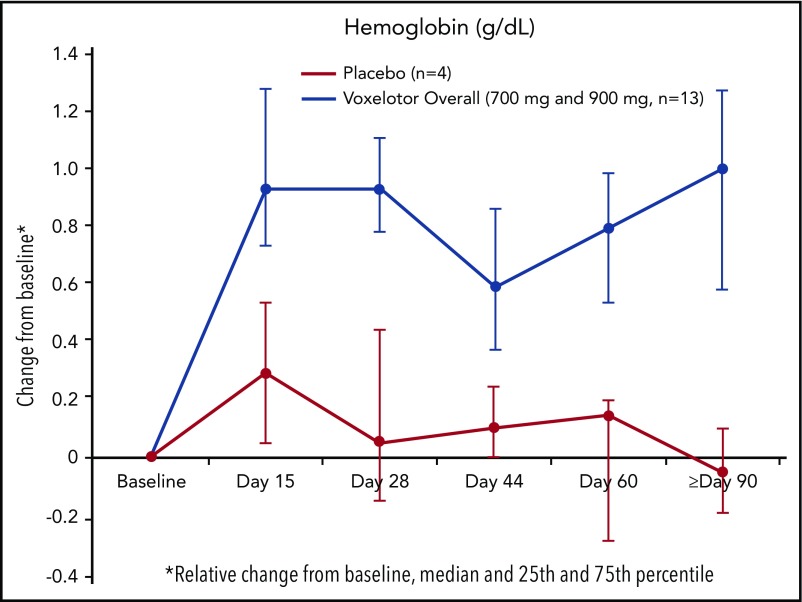
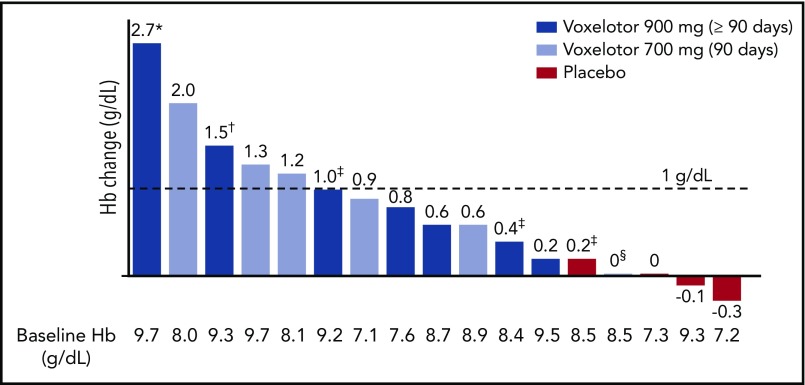
New treatments directly targeting polymerization of sickle hemoglobin (HbS), the proximate event in the pathophysiology of sickle cell disease (SCD), are needed to address the severe morbidity and early mortality associated with the disease. Voxelotor (GBT440) is a first-in-class oral therapy specifically developed to treat SCD by modulating the affinity of hemoglobin (Hb) for oxygen, thus inhibiting HbS polymerization and downstream adverse effects of hemolytic anemia and vaso-occlusion. GBT440-001 was a phase 1/2 randomized, double-blind, placebo-controlled, single and multiple ascending dose study of voxelotor in adult healthy volunteers and patients with SCD, followed by a single-arm, open-label extension study. This report describes results of voxelotor (500-1000 mg per day) in patients with sickle cell anemia. The study evaluated the safety, tolerability, pharmacokinetic, and pharmacodynamic properties of voxelotor and established proof of concept by improving clinical measures of anemia, hemolysis, and sickling. Thirty-eight patients with SCD received 28 days of voxelotor 500, 700, or 1000 mg per day or placebo; 16 patients received 90 days of voxelotor 700 or 900 mg per day or placebo. Four patients from the 90-day cohort were subsequently enrolled in an extension study and treated with voxelotor 900 mg per day for 6 months. All patients who received multiple doses of voxelotor for ≥28 days experienced hematologic improvements including increased Hb and reduction in hemolysis and percentage of sickled red cells, supporting the potential of voxelotor to serve as a disease-modifying therapy for SCD. Voxelotor was well tolerated with no treatment-related serious adverse events and no evidence of tissue hypoxia. These trials were registered at www.clinicaltrials.gov as #NCT02285088 and #NCT03041909.
© 2019 by The American Society of Hematology.
Conflict of interest statement
Conflict-of-interest disclosure: J.H. is a consultant/advisor for Novartis; Global Blood Therapeutics, Inc; Bluebird Bio; and Terumo BCT. P.T. is a consultant/advisor for Apopharma; Bluebird Bio; Global Blood Therapeutics, Inc; Novartis; and Terumo. D.M.L. is a consultant/advisor for Agios, Cerus, and Novartis. J.P. received research funding from Novartis; was a consultant/advisor for Novartis, Shire, and Celgene; and received honoraria from Novartis and Celgene. M.A. is a consultant for, and receives honoraria from, Novartis. T.M. is an employee of, and owns shares of, IQVIA. D.D.G. is an independent consultant. K.D., A.H., M.P., V.S., S.D., M.T., and J.L.-G. are employees of, and have equity ownership in, Global Blood Therapeutics, Inc. N.L. is a consultant clinical site liaison for Global Blood Therapeutics, Inc. C.J.H. declares no competing financial interests.
Figures



Comment in
-
Primary polymerization prevention.Blood. 2019 Apr 25;133(17):1797-1798. doi: 10.1182/blood-2019-02-898767. Blood. 2019. PMID: 31023742 No abstract available.
References
-
- Piel FB, Steinberg MH, Rees DC. Sickle cell disease. N Engl J Med. 2017;376(16):1561-1573. - PubMed
-
- Bunn HF. Pathogenesis and treatment of sickle cell disease. N Engl J Med. 1997;337(11):762-769. - PubMed
-
- Powars DR, Chan LS, Hiti A, Ramicone E, Johnson C. Outcome of sickle cell anemia: a 4-decade observational study of 1056 patients. Medicine (Baltimore). 2005;84(6):363-376. - PubMed
-
- Hassell KL. Population estimates of sickle cell disease in the U.S. Am J Prev Med. 2010;38(suppl 4):S512-S521. - PubMed
