Randomized Controlled Trial
. 2022 Apr 1;12(1):5517.
doi: 10.1038/s41598-022-09307-5.

Strain-resolved analysis in a randomized trial of antibiotic pretreatment and maintenance dose delivery mode with fecal microbiota transplant for ulcerative colitis

Affiliations
Randomized Controlled Trial

Strain-resolved analysis in a randomized trial of antibiotic pretreatment and maintenance dose delivery mode with fecal microbiota transplant for ulcerative colitis

Byron J Smith et al. Sci Rep. .

Abstract

Fecal microbiota transplant is a promising therapy for ulcerative colitis. Parameters maximizing effectiveness and tolerability are not yet clear, and it is not known how import the transmission of donor microbes to patients is. Here (clinicaltrails.gov: NCT03006809) we have tested the effects of antibiotic pretreatment and compared two modes of maintenance dose delivery, capsules versus enema, in a randomized, pilot, open-label, 2 × 2 factorial design with 22 patients analyzed with mild to moderate UC. Clinically, the treatment was well-tolerated with favorable safety profile. Of patients who received antibiotic pretreatment, 6 of 11 experienced remission after 6 weeks of treatment, versus 2 of 11 non-pretreated patients (log odds ratio: 1.69, 95% confidence interval: -0.25 to 3.62). No significant differences were found between maintenance dosing via capsules versus enema. In exploratory analyses, microbiome turnover at both the species and strain levels was extensive and significantly more pronounced in the pretreated patients. Associations were also revealed between taxonomic turnover and changes in the composition of primary and secondary bile acids. Together these findings suggest that antibiotic pretreatment contributes to microbiome engraftment and possibly clinical effectiveness, and validate longitudinal strain tracking as a powerful way to monitor the dynamics and impact of microbiota transfer.


Conflict of interest statement

YMP is an employee of Symbiome, Inc. ZK is an employee/shareholder at Finch Therapeutics. SVL is co-founder and shareholder of Siolta Therapeutics, Inc. and serves as both a consultant and a member of its Board of Directors. KSP is on the scientific advisory board of Phylagen. NE has received research support from Finch Therapeutics and Assembly Biosciences, and has been a consultant for Federation Bio and Ferring Pharmaceuticals. All other authors declare no competing interests.

Figures
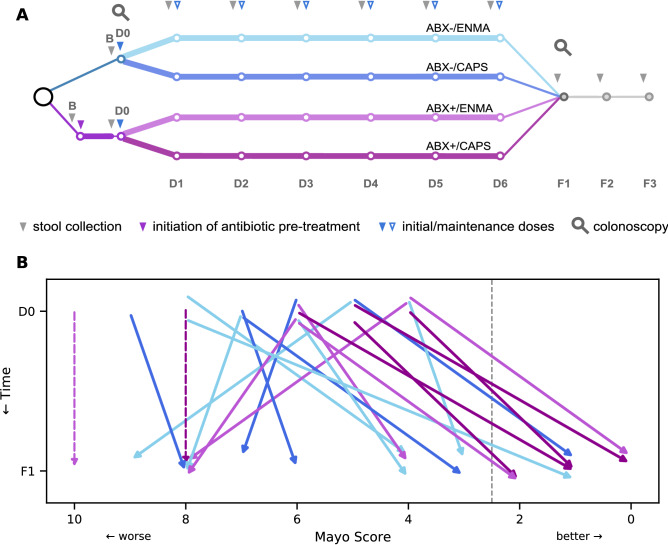
Figure 1
Figure 1
Study design and primary efficacy endpoint of an experimental FMT treatment for UC, showing improved symptoms at follow-up, particularly among patients receiving antibiotics. In our 2 × 2 factorial design, each patient either received antibiotic pretreatment (ABX +) or not (ABX−), and either received capsules (CAPS) or enema (ENMA) for maintenance dosing. (A) Major events during the longitudinal study, including baseline (B) and subsequent fecal sample collections (grey arrowheads), colonoscopies (magnifying glasses), initial FMT (D0, solid blue arrowhead), 6 weekly maintenance doses (D1–D6, open blue arrowheads), and three follow-up appointments (F1–F3). The start of oral antibiotics is represented (purple arrowhead). (B) Change in Mayo scores of each patient between D0 (top) and F1 (bottom). Dashed arrows show the D0 Mayo score of patients who withdrew from the study due to worsening symptoms. Patient arrows are colored by arm and shifted vertically by a small, arbitrary amount to increase visual distinction. The grey dotted line just left of Mayo score 2 marks the remission threshold. All patients with a Mayo score ≤ 2 at F1 also had an endoscopy sub-score that decreased by at least 1 point; therefore, all were considered to be in remission.
Figure 2
Figure 2
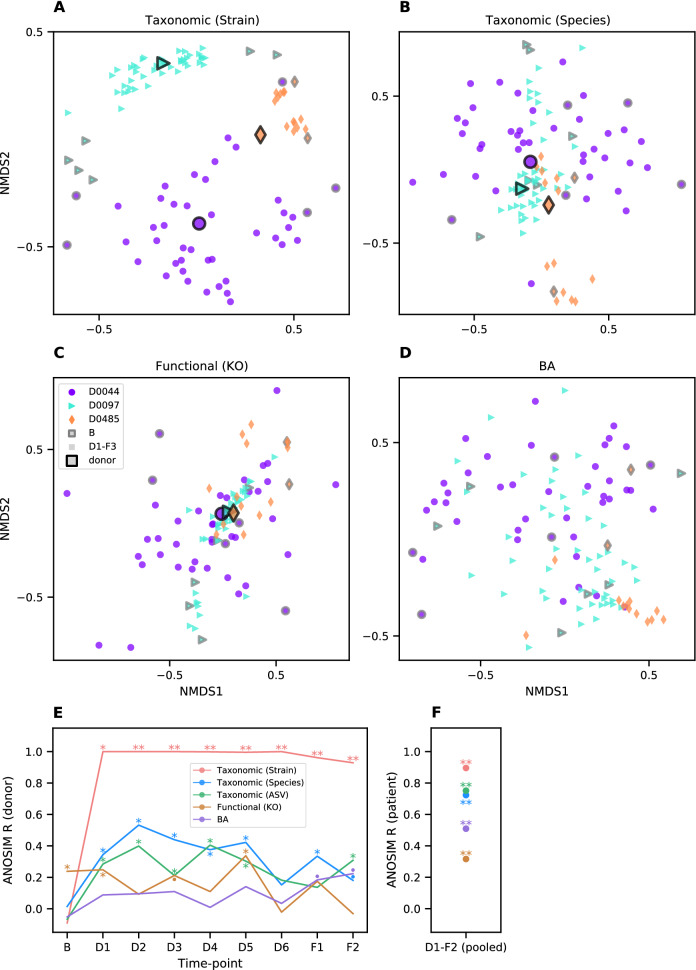
Samples cluster within patient and donor groups during and after FMT treatment. (A–D) Non-metric multidimensional scalings were calculated from pairwise sample comparisons based on BC dissimilarity of taxonomic profiles from shotgun metagenomes at strain (A), and species resolution (B), and on cosine dissimilarity of functional gene (C) and BA profiles (D). The orientations and scales of axes are arbitrary, and proximity on a plot reflects similarity. Markers represent individual fecal samples from patients (no black outline) or the mean of all samples from a single donor (black outlines). Shapes and colors are matched between patients and their respective donors. Patients’ baseline samples are outlined in grey. Identical ordinations colored by individual subjects are available in Supplementary Fig. S1. (E,F) ANOSIM R scores, an index of clustering strength based on pairwise sample dissimilarities, for the four profiles from (A–D) as well as an additional taxonomic profile based on 16S rRNA gene ASVs. Larger R values indicate stronger clustering by donor at each time point (E) or by patient across pooled time points (F). Significance, as assessed by ANOSIM permutation test (n = 9999): p ≤ 0.1 (▪), p ≤ 0.05 (*), p ≤ 0.001 (**).
Figure 3
Figure 3
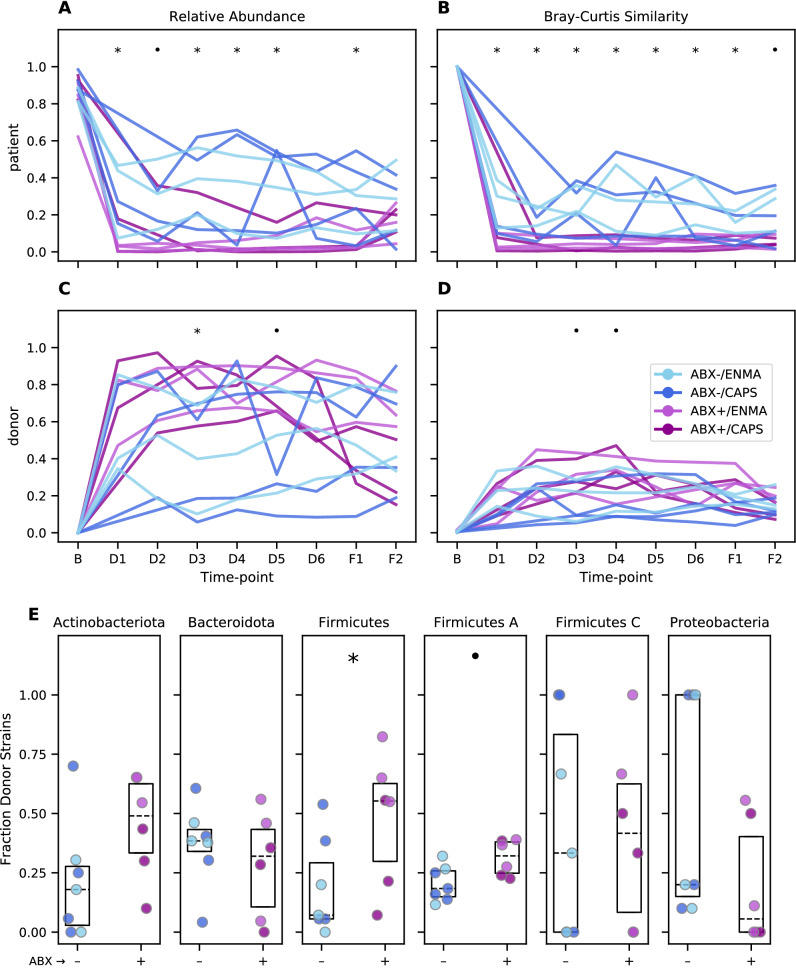
Greater community perturbation and engraftment of donor strains following FMT treatment in antibiotic-pretreated patients. (A,C) Abundance of strains specific to each patient’s baseline sample (A) or specific to each donor sample (C) relative to the patient’s total strain populations over the course of treatment. (B,D) BC similarity (1—BC dissimilarity) between each patient’s sample and that patient’s own baseline (B) or their assigned donor (D). (E) Fraction of donor strains detected in each patient’s fecal samples at F1. Each dot represents a patient, colors are as in (A–D). Boxes span the interquartile range with the median also marked (dotted line). In all panels, symbols indicate individual time points (A–D) and taxa (E) with p-values less than 0.1 (·) or 0.05 (*) by MWU test for differences between patients who did or did not receive antibiotic pretreatment.
Figure 4
Figure 4
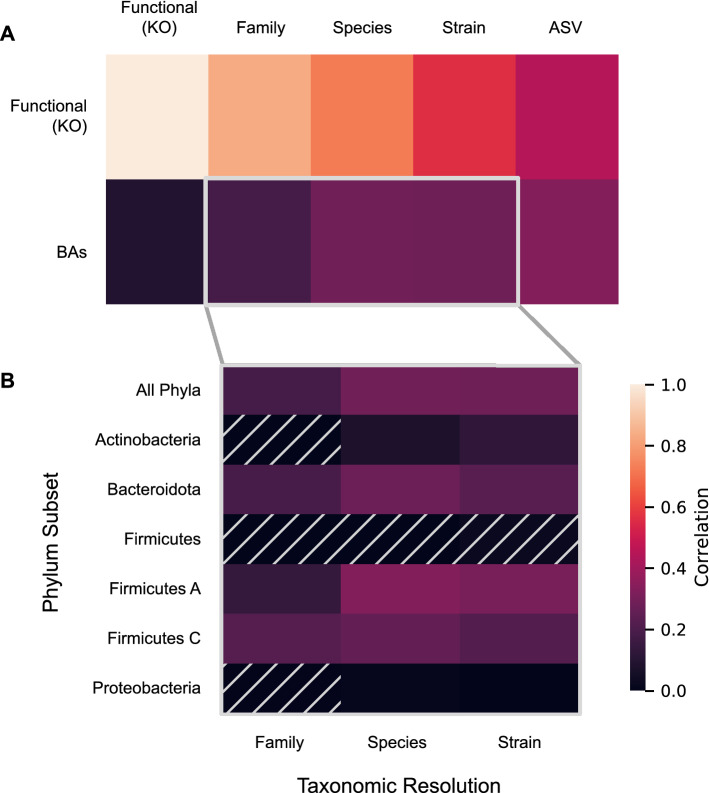
Changes across taxonomic, functional, and BA profiles are correlated. Heatmap tiles depict Pearson correlation coefficients between all within-patient pairwise dissimilarity scores, controlling for time, with brighter colors indicating a stronger association between profiles. Comparisons are for (A) each pairwise comparison between taxonomic and functional gene profiles with BA and functional gene profiles, or (B) BAs, specifically, compared across taxonomic profiles at different resolutions (X-axis) and phylum-level subsets (Y-axis). Hatched cells indicate comparisons where p-values are > 0.05 by Mantel permutation test (n = 9999); all other comparisons are significant at or below this threshold.

References

    1. Yalchin M, et al. Gaps in knowledge and future directions for the use of faecal microbiota transplant in the treatment of inflammatory bowel disease. Ther. Adv. Gastroenterol. 2019;12:1756284819891038. - PMC - PubMed
    1. Lopetuso LR, et al. Fecal transplantation for ulcerative colitis: Current evidence and future applications. Expert Opin. Biol. Ther. 2020;20:343–351. - PubMed
    1. Paramsothy S, et al. Faecal microbiota transplantation for inflammatory bowel disease: A systematic review and meta-analysis. J. Crohns Colitis. 2017;11:1180–1199. - PubMed
    1. Costello SP, et al. Systematic review with meta-analysis: Faecal microbiota transplantation for the induction of remission for active ulcerative colitis. Aliment. Pharmacol. Ther. 2017;46:213–224. - PubMed
    1. Lam TJ, Ye Y. CRISPRs for strain tracking and their application to microbiota transplantation data analysis. CRISPR J. 2019;2:41–50. - PMC - PubMed

Publication types

Substances

Associated data