


Efficacy and safety of equine anti-thymocyte immunoglobulin (eATG) in three Japanese patients with moderate to very severe aplastic anemia: a case series
- PMID: 36441357
- PMCID: PMC9876848
- DOI: 10.1007/s12185-022-03496-5
Efficacy and safety of equine anti-thymocyte immunoglobulin (eATG) in three Japanese patients with moderate to very severe aplastic anemia: a case series
Erratum in
-
Correction: Efficacy and safety of equine anti-thymocyte immunoglobulin (eATG) in three Japanese patients with moderate to very severe aplastic anemia: a case series.Int J Hematol. 2023 Mar;117(3):469. doi: 10.1007/s12185-023-03543-9. Int J Hematol. 2023. PMID: 36696019 Free PMC article. No abstract available.
Abstract
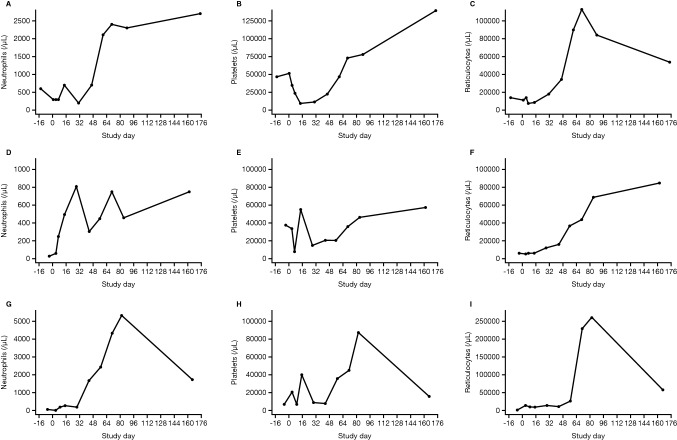
Aplastic anemia results from lymphocyte-mediated destruction of hematopoietic stem cells. Immunosuppressive therapy with anti-thymocyte globulin (ATG) and cyclosporine is the standard front-line treatment for patients with severe aplastic anemia who are not suitable candidates for stem cell transplants. PF-06462700 is a potent equine ATG that targets T-lymphocytes and has been approved as a treatment for aplastic anemia outside of Japan for over 30 years. Due to the high medical need for PF-06462700, the Ministry of Health, Labor and Welfare requested its development for Japanese patients with aplastic anemia. In this case series, the efficacy and safety of PF-06462700, administered intravenously at 40 mg/kg/day for 4 days, were assessed over a 24-week period. This was as an open-label, single-arm, multicenter clinical study designed to enroll a minimum of three Japanese participants with aplastic anemia. Two participants met the primary outcome of hematologic response at week 12 and improvements in disease severity were observed. No deaths or serious adverse events were reported. The efficacy results from this case series suggest that administration of PF-06462700 is generally well-tolerated and produces a hematologic response in Japanese patients with aplastic anemia, which should be further evaluated in real-world studies.ClinicalTrials.gov identifier: NCT04350606.
Keywords: Aplastic anemia; Equine anti-thymocyte immunoglobulin; Hematologic response; Safety; eATG.
© 2022. Japanese Society of Hematology.
Conflict of interest statement
YK, TM, and AN have no conflicts to declare. KDW is an employee and shareholder of Pfizer Inc. KN is an employee and shareholder of Pfizer R&D Japan. HY is an employee of Pfizer R&D Japan.
Figures
References
-
- Ohta A, Nagai M, Nishina M, Shimada N, Nakao S, Kurokawa M. Incidence of aplastic anemia in Japan: analysis of data from a nationwide registration system. Int J Epidemiol. 2015;44:i178–i. doi: 10.1093/ije/dyv096.259. - DOI
-
- Frickhofen N, Kaltwasser JP, Schrezenmeier H, Raghavachar A, Vogt HG, Herrmann F, et al. Treatment of aplastic anemia with antilymphocyte globulin and methylprednisolone with or without cyclosporine. The German aplastic anemia study group. N Engl J Med. 1991;324:1297–304. doi: 10.1056/NEJM199105093241901. - DOI - PubMed
Publication types
MeSH terms
Substances
Associated data
LinkOut - more resources
Full Text Sources
Medical
Miscellaneous
