


Efficacy and Safety of Carboxytherapy versus Combined Microneedling with Topical Glutathione in the Treatment of Patients with Periorbital Hyperpigmentation: An Evaluator-Blind, Split-Face, Controlled Pilot Clinical Trial
- PMID: 36865870
- PMCID: PMC9971752
- DOI: 10.4103/ijd.ijd_394_21
Efficacy and Safety of Carboxytherapy versus Combined Microneedling with Topical Glutathione in the Treatment of Patients with Periorbital Hyperpigmentation: An Evaluator-Blind, Split-Face, Controlled Pilot Clinical Trial
Abstract
Background: Periorbital hyperpigmentation (POH) is a common skin condition that presents as infraorbital darkening. POH has a multifactorial etiology. Studies evaluating POH treatment are several with varying satisfaction results.
Objectives: To compare carboxytherapy and microneedling (MN) combined with topical glutathione for POH treatment.
Materials and methods: A split-face pilot clinical trial was conducted on 31 female patients with POH. Carboxytherapy injection was done at the right periorbital area, and MN with topical glutathione (Left periorbital area), for 6 biweekly sessions. Visual analogue scale (VAS), dermoscopic evaluation, patient satisfaction, and patient dermatology life quality index questionnaire (DLQI), safety evaluation were done with 3 months follow up. The trial registry number is NCT04389788.
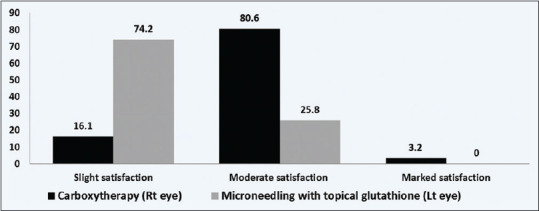
Results: Carboxytherapy showed a higher significant improvement as regards VAS evaluation compared to MN with glutathione during the active treatment phase (P = 0.001) and during the follow-up phase (P = 0.006). Also, the dermoscopic evaluation showed a statistically significant improvement in the Carboxytherapy group. DLQI showed a statistically significant improvement (P <.001). As regards patient satisfaction, carboxytherapy showed in comparison to MN with glutathione (80.6% vs 25.8% in moderate satisfaction) and (3.2% vs 0% in marked satisfaction respectively) (P = .05). As regards the patients' safety, there was no significant difference between both eyes (P = .23).
Conclusions: Carboxytherapy showed higher efficacy than MN with glutathione in POH patients. Carboxytherapy improved clinical, dermoscopic, patient satisfaction, and patient DLQI; with a good safety profile.
Keywords: Carboxytherapy; microneedling; periorbital hyperpigmentation; topical glutathione.
Copyright: © 2022 Indian Journal of Dermatology.
Conflict of interest statement
There are no conflicts of interest.
Figures



References
-
- Roh MR, Chung KY. Infraorbital dark circles: Definition, causes, and treatment options. Dermatol Surg. 2009;35:1163–71. - PubMed
-
- Roberts WE. Periorbital hyperpigmentation: Review of etiology, medical evaluation, and aesthetic treatment. J Drugs Dermatol. 2014;13:472–82. - PubMed
-
- Cymbalista NC, Prado de Oliveira ZN. Treatment of idiopathic cutaneous hyperchromia of the orbital region (ICHOR) with intense pulsed light. Dermatol Surg. 2006;32:773–83. - PubMed
Associated data
LinkOut - more resources
Full Text Sources
Medical
Research Materials