


Enhanced control of periodontitis by an artificial intelligence-enabled multimodal-sensing toothbrush and targeted mHealth micromessages: A randomized trial
- PMID: 38631679
- PMCID: PMC11651722
- DOI: 10.1111/jcpe.13987
Enhanced control of periodontitis by an artificial intelligence-enabled multimodal-sensing toothbrush and targeted mHealth micromessages: A randomized trial
Abstract
Aim: Treatment of periodontitis, a chronic inflammatory disease driven by biofilm dysbiosis, remains challenging due to patients' poor performance and adherence to the necessary oral hygiene procedures. Novel, artificial intelligence-enabled multimodal-sensing toothbrushes (AI-MST) can guide patients' oral hygiene practices in real-time and transmit valuable data to clinicians, thus enabling effective remote monitoring and guidance. The aim of this trial was to assess the effect of such a system as an adjunct to clinical practice guideline-conform treatment.
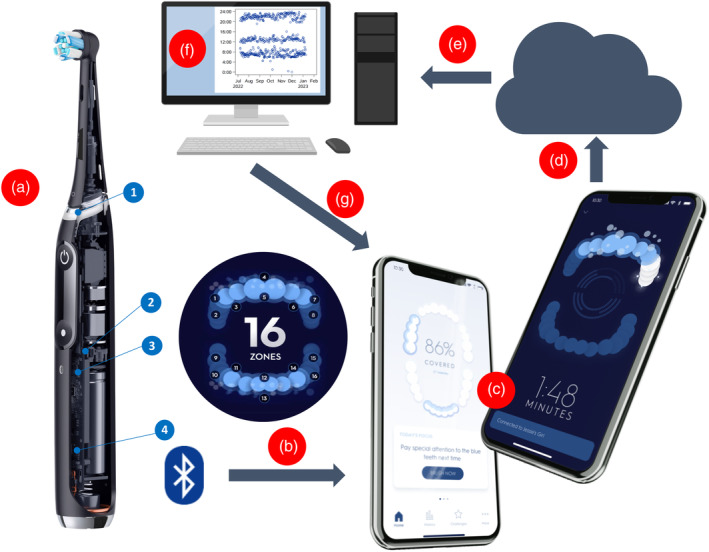
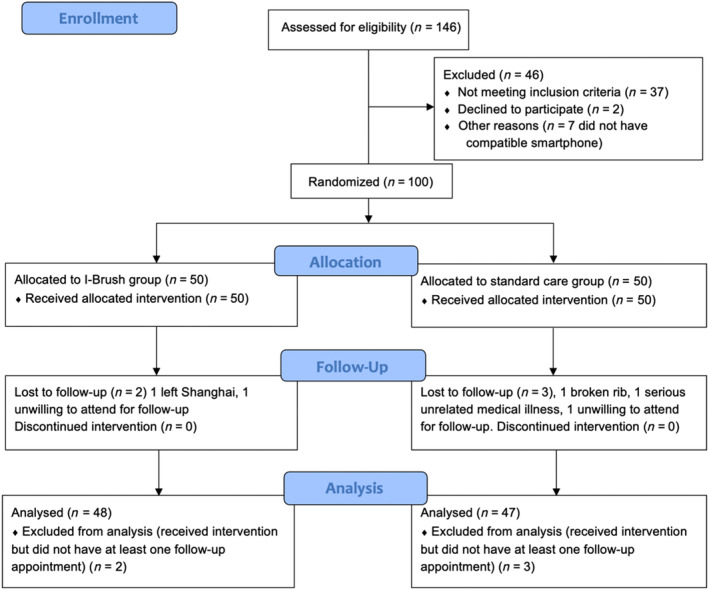
Materials and methods: This was a single-centre, double-blind, standard-of-care controlled, randomized, parallel-group, superiority trial. Male and female adults with generalized Stage II/III periodontitis were recruited at the Shanghai Ninth People's Hospital, China. Subjects received a standard-of-care oral hygiene regimen or a technology-enabled, theory-based digital intervention consisting of an AI-MST and targeted doctor's guidance by remote micromessaging. Additionally, both groups received guideline-conform periodontal treatment. The primary outcome was the resolution of inflamed periodontal pockets (≥4 mm with bleeding on probing) at 6 months. The intention-to-treat (ITT) analysis included all subjects who received the allocated treatment and at least one follow-up.
Results: One hundred patients were randomized and treated (50 tests/controls) between 1 February and 30 November 2022. Forty-eight tests (19 females) and 47 controls (16 females) were analysed in the ITT population. At 6 months, the proportion of inflamed periodontal pockets decreased from 80.7% (95% confidence interval [CI] 76.5-84.8) to 52.3% (47.7-57.0) in the control group, and from 81.4% (77.1-85.6) to 44.4% (39.9-48.9) in the test group. The inter-group difference was 7.9% (1.6-14.6, p < .05). Test subjects achieved better levels of oral hygiene (p < .001). No significant adverse events were observed.
Conclusions: The tested digital health intervention significantly improved the outcome of periodontal therapy by enhancing the adherence and performance of self-performed oral hygiene. The model breaks the traditional model of oral health care and has the potential to improve efficiency and reduce costs (NCT05137392).
Keywords: artificial intelligence; digital health intervention; mHealth; periodontitis; power toothbrush; randomized controlled trial.
© 2024 The Authors. Journal of Clinical Periodontology published by John Wiley & Sons Ltd.
Conflict of interest statement
Maurizio S. Tonetti received grant support and/or personal fees from Geistlich Pharma AG, Straumann AG, Nobel Biocare and Sunstar SA, which are, however, unrelated to the present work. The other authors report no conflict of interest.
Figures
References
-
- Adam, R. , Zou, Y. , Grender, J. , Mesples, U. , Erb, J. , & Bray, K. K. (2023). Brushing behavior changes and plaque removal with an electric toothbrush: A clinical trial. Journal of Dental Hygiene, 97(5), 155–165. - PubMed
-
- Arias‐Bujanda, N. , Regueira‐Iglesias, A. , Balsa‐Castro, C. , Nibali, L. , Donos, N. , & Tomás, I. (2020). Accuracy of single molecular biomarkers in saliva for the diagnosis of periodontitis: A systematic review and meta‐analysis. Journal of Clinical Periodontology, 47(1), 2–18. 10.1111/jcpe.13202 - DOI - PubMed
-
- Blanco‐Pintos, T. , Regueira‐Iglesias, A. , Seijo‐Porto, I. , Balsa‐Castro, C. , Castelo‐Baz, P. , Nibali, L. , & Tomás, I. (2023). Accuracy of periodontitis diagnosis obtained using multiple molecular biomarkers in oral fluids: A systematic review and meta‐analysis. Journal of Clinical Periodontology, 50(11), 1420–1443. 10.1111/jcpe.13854 - DOI - PubMed
Publication types
MeSH terms
Associated data
Grants and funding
LinkOut - more resources
Full Text Sources
Medical
