


Disruption and overexpression of Arabidopsis phytosulfokine receptor gene affects cellular longevity and potential for growth
- PMID: 16829587
- PMCID: PMC1557600
- DOI: 10.1104/pp.106.081109
Disruption and overexpression of Arabidopsis phytosulfokine receptor gene affects cellular longevity and potential for growth
Abstract
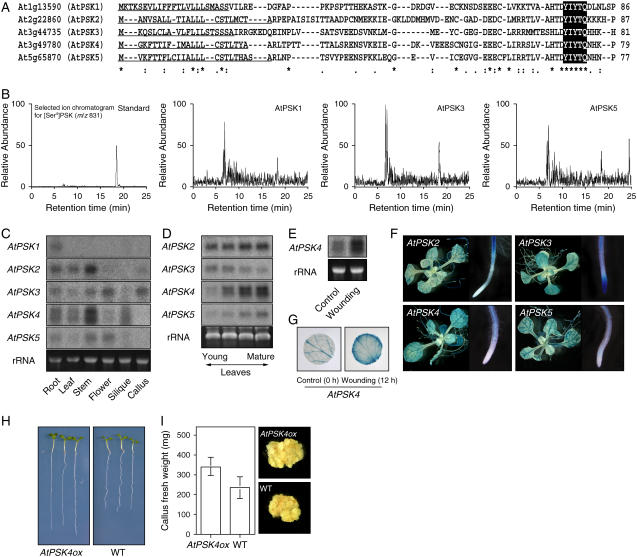
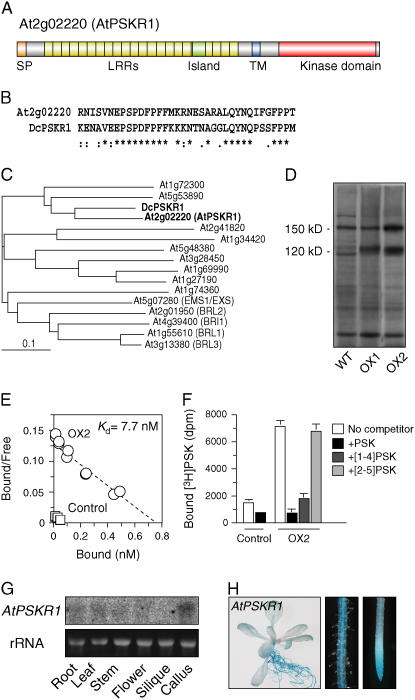
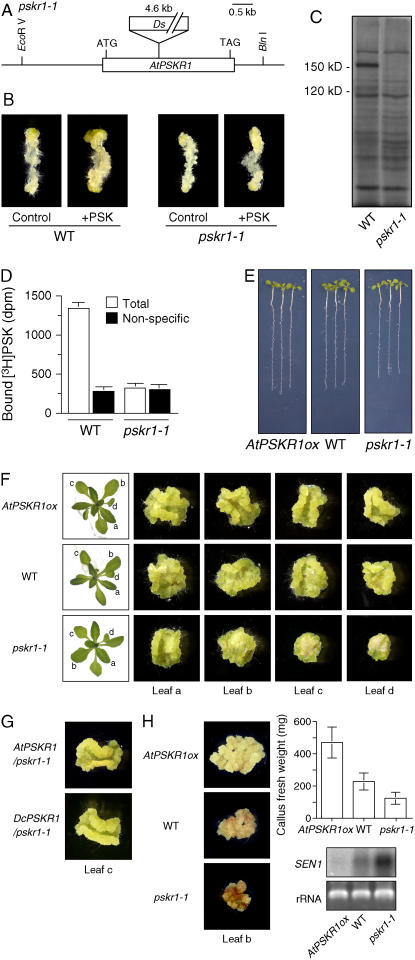
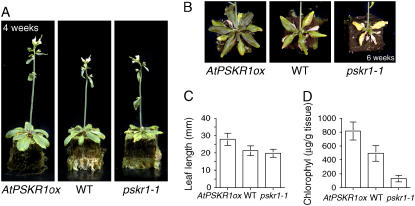
Phytosulfokine (PSK), a 5-amino acid sulfated peptide that has been identified in conditioned medium of plant cell cultures, promotes cellular growth in vitro via binding to the membrane-localized PSK receptor. Here, we report that loss-of-function and gain-of-function mutations of the Arabidopsis (Arabidopsis thaliana) PSK receptor gene (AtPSKR1) alter cellular longevity and potential for growth without interfering with basic morphogenesis of plants. Although mutant pskr1-1 plants exhibit morphologically normal growth until 3 weeks after germination, individual pskr1-1 cells gradually lose their potential to form calluses as tissues mature. Shortly after a pskr1-1 callus forms, it loses potential for growth, resulting in formation of a smaller callus than the wild type. Leaves of pskr1-1 plants exhibit premature senescence after bolting. Leaves of AtPSKR1ox plants exhibit greater longevity and significantly greater potential for callus formation than leaves of wild-type plants, irrespective of their age. Calluses derived from AtPSKR1ox plants maintain their potential for growth longer than wild-type calluses. Combined with our finding that PSK precursor genes are more strongly expressed in mature plant parts than in immature plant parts, the available evidence indicates that PSK signaling affects cellular longevity and potential for growth and thereby exerts a pleiotropic effect on cultured tissue in response to environmental hormonal conditions.
Figures
References
-
- Bellincampi D, Morpurgo G (1987) Conditioning factor affecting growth in plant cells in culture. Plant Sci 51: 83–91
-
- Birnberg PR, Somers DA, Brenner ML (1988) Characterization of conditioning factors that increase colony formation from Black Mexican sweet corn protoplasts. J Plant Physiol 132: 316–321
-
- Canales C, Bhatt AM, Scott R, Dickinson H (2002) EXS, a putative LRR receptor kinase, regulates male germline cell number and tapetal identity and promotes seed development in Arabidopsis. Curr Biol 12: 1718–1727 - PubMed
-
- Cano-Delgado A, Yin Y, Yu C, Vafeados D, Mora-Garcia S, Cheng JC, Nam KH, Li J, Chory J (2004) BRL1 and BRL3 are novel brassinosteroid receptors that function in vascular differentiation in Arabidopsis. Development 131: 5341–5351 - PubMed
-
- Chen YF, Matsubayashi Y, Sakagami Y (2000) Peptide growth factor phytosulfokine-α contributes to the pollen population effect. Planta 211: 752–755 - PubMed
Publication types
MeSH terms
Substances
Associated data
- Actions
- Actions
- Actions
- Actions
- Actions
- Actions
LinkOut - more resources
Full Text Sources
Other Literature Sources
Molecular Biology Databases
Research Materials
Miscellaneous
