


Structures of GRP94-nucleotide complexes reveal mechanistic differences between the hsp90 chaperones
- PMID: 17936703
- PMCID: PMC2094010
- DOI: 10.1016/j.molcel.2007.08.024
Structures of GRP94-nucleotide complexes reveal mechanistic differences between the hsp90 chaperones
Abstract
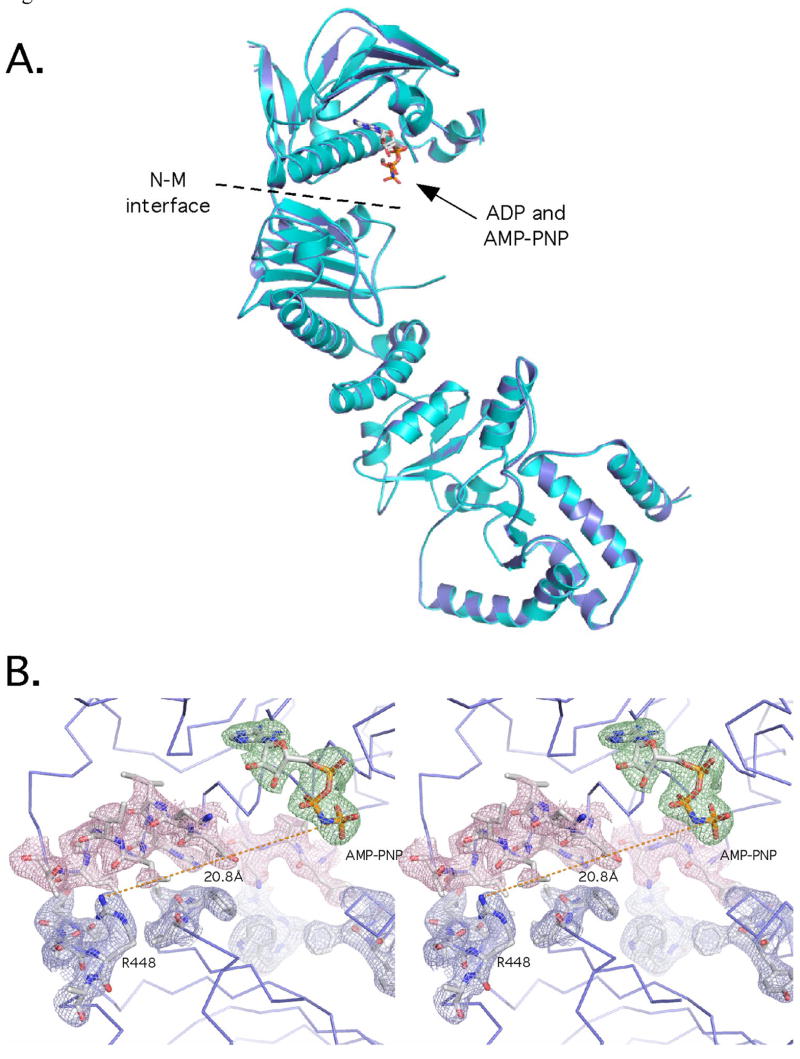
GRP94, an essential endoplasmic reticulum chaperone, is required for the conformational maturation of proteins destined for cell-surface display or export. The extent to which GRP94 and its cytosolic paralog, Hsp90, share a common mechanism remains controversial. GRP94 has not been shown conclusively to hydrolyze ATP or bind cochaperones, and both activities, by contrast, result in conformational changes and N-terminal dimerization in Hsp90 that are critical for its function. Here, we report the 2.4 A crystal structure of mammalian GRP94 in complex with AMPPNP and ADP. The chaperone is conformationally insensitive to the identity of the bound nucleotide, adopting a "twisted V" conformation that precludes N-terminal domain dimerization. We also present conclusive evidence that GRP94 possesses ATPase activity. Our observations provide a structural explanation for GRP94's observed rate of ATP hydrolysis and suggest a model for the role of ATP binding and hydrolysis in the GRP94 chaperone cycle.
Figures




Comment in
-
A Grp on the Hsp90 mechanism.Mol Cell. 2007 Oct 26;28(2):177-9. doi: 10.1016/j.molcel.2007.10.007. Mol Cell. 2007. PMID: 17964255 Review.
References
Publication types
MeSH terms
Substances
Associated data
- Actions
- Actions
- Actions
- Actions
Grants and funding
LinkOut - more resources
Full Text Sources
Other Literature Sources
Miscellaneous
