


A randomized, double-blind comparison of OROS(R) hydromorphone and controlled-release morphine for the control of chronic cancer pain
- PMID: 18976472
- PMCID: PMC2644667
- DOI: 10.1186/1472-684X-7-17
A randomized, double-blind comparison of OROS(R) hydromorphone and controlled-release morphine for the control of chronic cancer pain
Abstract
Background: Long-acting opioid formulations are advocated for maintaining pain control in chronic cancer pain. OROS(R) hydromorphone is a sustained-release formulation of hydromorphone that requires dosing once daily to maintain therapeutic concentrations. The objective of this study was to demonstrate the clinical equivalence of immediate-release and sustained-release formulations of hydromorphone and morphine for chronic cancer pain.
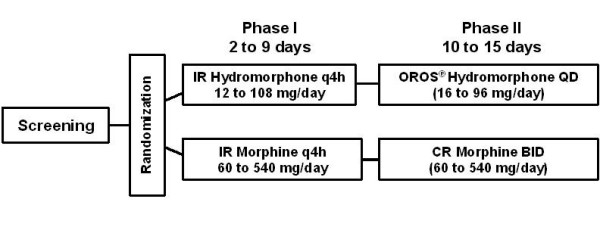
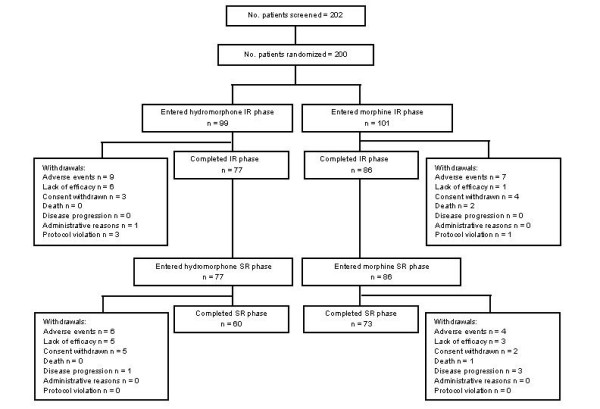
Methods: 200 patients with cancer pain (requiring </= 540 mg/d of oral morphine) participated in this double-blind, parallel-group trial. Patients were randomized to receive hydromorphone or morphine (immediate-release for 2-9 days, sustained-release for 10-15 days). Efficacy was assessed with the Brief Pain Inventory (BPI), investigator and patient global evaluations, Eastern Cooperative Oncology Group performance status, and the Mini-Mental State Examination. The primary endpoint was the 'worst pain in the past 24 hours' item of the BPI, in both the immediate-release and sustained-release study phases, with treatments deemed equivalent if the 95% confidence intervals (CI) of the between-group differences at endpoint were between -1.5 and 1.5. No equivalence limits were defined for secondary endpoints.
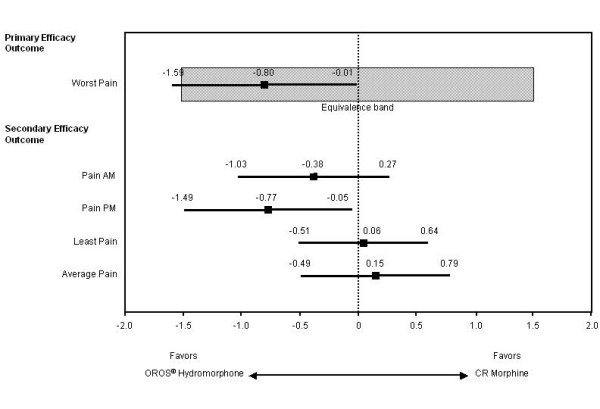
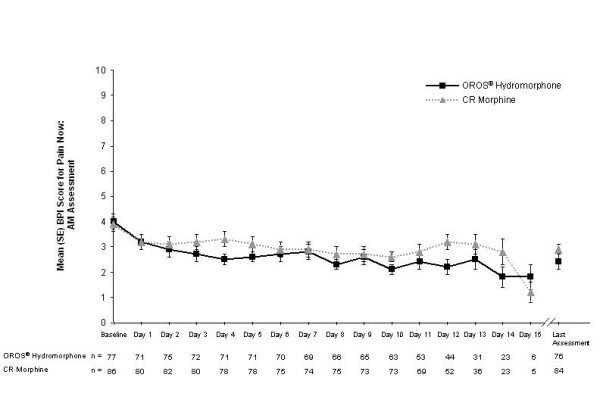
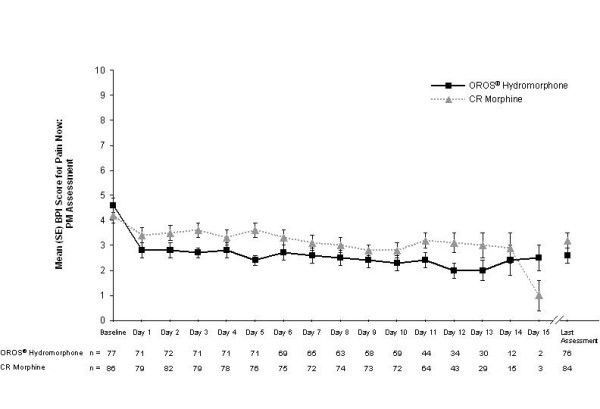
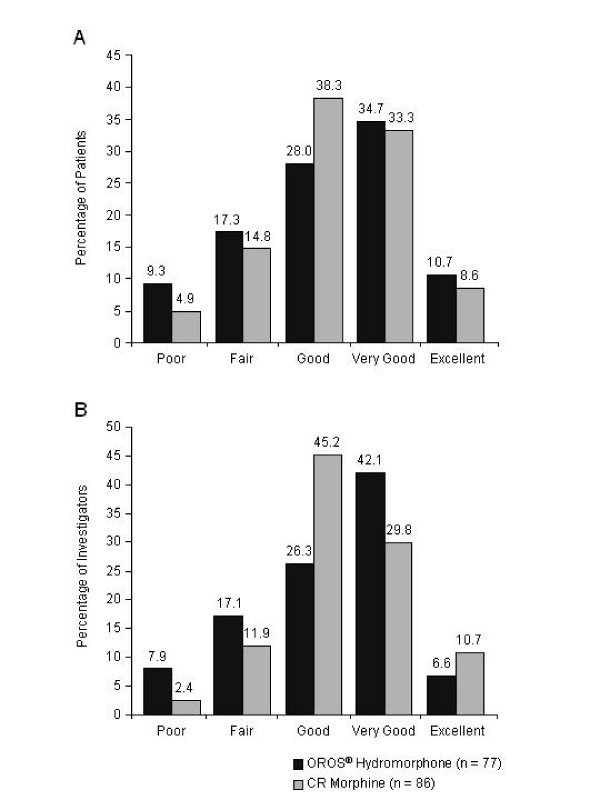
Results: Least-squares mean differences (95% CI) between groups were 0.2 (-0.4, 0.9) in the immediate-release phase and -0.8 (-1.6, -0.01) in the sustained-release phase (intent-to-treat population), indicating that the immediate-release formulations met the pre-specified equivalence criteria, but that the lower limit of the 95% CI (-1.6) was outside the boundary (-1.5) for the sustained-release formulations. BPI 'pain now PM' was significantly lower with OROS(R) hydromorphone compared with controlled-release morphine (least-squares mean difference [95% CI], -0.77 [-1.49, -0.05]; p = 0.0372). Scores for other secondary efficacy variables were similar between the two sustained-release treatments. At endpoint, > 70% of investigators and patients rated both treatments as good to excellent. The safety profiles of hydromorphone and morphine were similar and typical of opioid analgesics.
Conclusion: Equivalence was demonstrated for immediate-release formulations of hydromorphone and morphine, but not for the sustained-release formulations of OROS(R) hydromorphone and controlled-release morphine. The direction of the mean difference between the treatments (-0.8) and the out-of-range lower limit of the 95% CI (-1.6) were in favor of OROS(R) hydromorphone.
Trial registration: ClinicalTrials.gov: NCT0041054.
Trial registration: ClinicalTrials.gov NCT00041054.
Figures
References
-
- Ventafridda V, Caraceni A, Gamba A. Field-testing of the WHO guidelines for cancer pain relief. Summary report of demonstration projects. In: Foley KM, Bonica JJ, Ventafridda V, editor. Advances in Pain Research and Therapy. New York: Raven Press, Ltd.; 1990. pp. 451–64.
-
- World Health Organization . Report of a WHO Expert Committee Technical Report Series 804. Geneva, Switzerland: World Health Organization; 1990. Cancer pain relief and palliative care; pp. 1–75.http://www.who.int/en/ - PubMed
-
- Hanks GW, Conno F, Cherny N, Hanna M, Kalso E, McQuay HJ, Mercadante S, Meynadier J, Poulain P, Ripamonti C, Radbruch L, Casas JR, Sawe J, Twycross RG, Ventafridda V. Morphine and alternative opioids in cancer pain: the EAPC recommendations. Br J Cancer. 2001;84:587–93. doi: 10.1054/bjoc.2001.1680. - DOI - PMC - PubMed
-
- American Pain Society . Principles of Analgesic Use in the Treatment of Acute Pain and Cancer Pain. 5. Glenview, IL: American Pain Society; 2003. http://www.ampainsoc.org/pub/principles.htm
Associated data
LinkOut - more resources
Full Text Sources
Medical
Miscellaneous
