. 1997 Apr 1;94(7):3414-9.
doi: 10.1073/pnas.94.7.3414.

The Caenorhabditis elegans gene unc-76 and its human homologs define a new gene family involved in axonal outgrowth and fasciculation

Affiliations

The Caenorhabditis elegans gene unc-76 and its human homologs define a new gene family involved in axonal outgrowth and fasciculation

L Bloom et al. Proc Natl Acad Sci U S A. .

Abstract

The gene unc-76 (unc, uncoordinated) is necessary for normal axonal bundling and elongation within axon bundles in the nematode Caenorhabditis elegans. The UNC-76 protein and two human homologs identified as expressed sequence tags are not similar to previously characterized proteins and thus represent a new protein family. At least one of these human homologs can function in C. elegans, suggesting that it, like UNC-76, acts in axonal outgrowth. We propose that the UNC-76 protein, which is found in cell bodies and processes of all neurons throughout development, either has a structural role in the formation and maintenance of axonal bundles or transduces signals to the intracellular machinery that regulates axonal extension and adhesion.


Figures
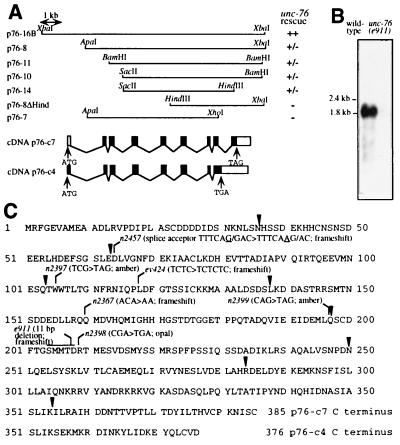
Figure 1
Figure 1
The unc-76 gene. (A) Structures of unc-76 genomic and cDNA clones. ++, restoration of locomotion of unc-76(e911) animals to that of the wild type; −, no effect on locomotion; ±, rescue in young larvae but poorer locomotion in older animals. Exons (black bars) and introns (thin lines) of the cDNA clones p76-c4 and p76-c7 are aligned with the genomic map. (B) unc-76 RNA. The 32P-labeled insert from p76-c4 was hybridized to 10 μg of poly(A)+ RNA from wild-type and unc-76(e911) mutant embryos. (C) UNC-76 protein sequences deduced from p76-c4 and p76-c7. The sequences are identical through amino acid 354, and the alternative C termini are shown beginning at amino acid 351. Exon boundaries (arrowheads) and positions affected by unc-76 mutations are indicated. The sequence deleted from e911 is ATCCGTCATCA.
Figure 2
Figure 2
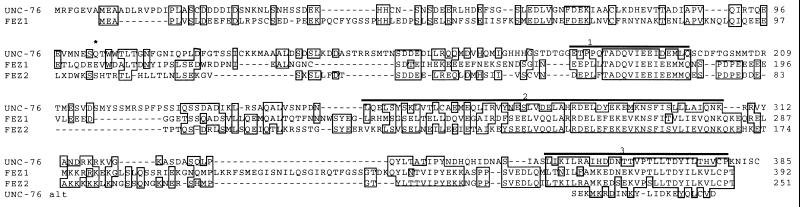
Alignment of C. elegans UNC-76 protein with two human homologs. Identical amino acids are boxed. Amino acids 1–98 of FEZ2 were inferred from the overlapping clone DY1C1TG01 (accession number F15259F15259), which probably lacks sequences encoding the N terminus of FEZ2. Longer FEZ2 clones were not present in dbEST. The alternatively spliced C terminus from p76-c4 is labeled UNC-76 alt. X, amino acid was ambiguous in the reported DY1C1TG01 sequence. ∗, C terminus of FEZ1-T. Bars labeled 1–3, regions of highest conservation.
Figure 3
Figure 3
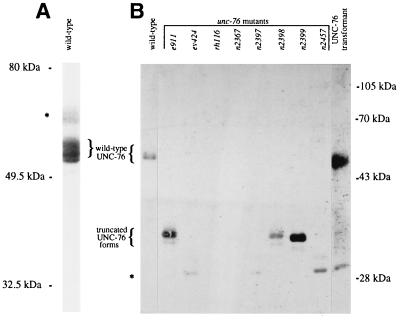
Immunoblots of UNC-76 protein. Proteins from mixed-stage populations of worms were separated on (A) 7.5% and (B) 10% polyacrylamide gels, blotted with affinity-purified anti-UNC-76 serum and reacted with a peroxidase-conjugated anti-rabbit antiserum and the ECL chemiluminescent reagent (Amersham). The UNC-76 transformant carried the rescuing plasmid p76–16B in an unc-76(e911) background and contained the e911 mutant form of UNC-76 protein, not visible in this exposure, in addition to the wild-type form. Bands indicated by asterisks probably do not represent UNC-76 protein, because they appeared in only a subset of samples from wild-type and unc-76 mutant animals in other experiments (data not shown) and were unaffected by unc-76 mutations.
Figure 4
Figure 4
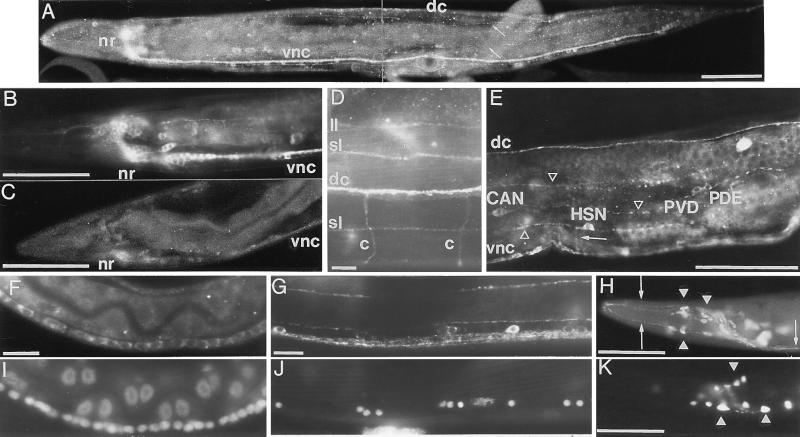
Localization of UNC-76 and UNC-76::β-galactosidase fusion proteins. Anterior is to the left, and dorsal is at the top. (A) UNC-76 protein in a wild-type adult is visible in the nerve ring (nr), ventral cord (vnc), dorsal cord (dc), and dorsal and ventral sublateral process tracts (arrows). UNC-76 protein in a wild-type adult (B) is more abundant than in an unc-76(ev424) mutant adult (C). (D) Dorsal region of a wild-type adult just anterior to the vulva. Staining is visible in the dorsal nerve cord (dc), dorsal sublateral tracts (sl), a left lateral tract (ll), and two motor commissures (c). (E) Midbody region of a wild-type adult. Staining is visible in cell bodies of PVDR, PDER, HSNR, and CANR as well as the dorsal (dc) and ventral (vnc) nerve cords, several longitudinal process tracts (arrowheads), and the circumferentially directed HSN axon (arrow). UNC-76 staining near the midbody region of L2 (F) and adult (G) ventral nerve cords and the corresponding nuclei visualized by diamidinophenolindole (I and J). (H) An UNC-86::UNC-76::β-galactosidase fusion protein encoded by p86/76–1 is localized to axons (arrow) as well as cell bodies (arrowheads) in a small set of neurons in the head of an adult stained with anti-β-galactosidase antibodies. (K) The equivalent UNC-86::β-galactosidase fusion protein lacking UNC-76 sequences (encoded by p86-L1) is confined primarily to cell bodies (arrowheads). Cell identities in H and K were not determined. [Bars = 50 μm (AC, E, H, and K) and 10 μm (D, F, G, I, and J).]
Figure 5
Figure 5
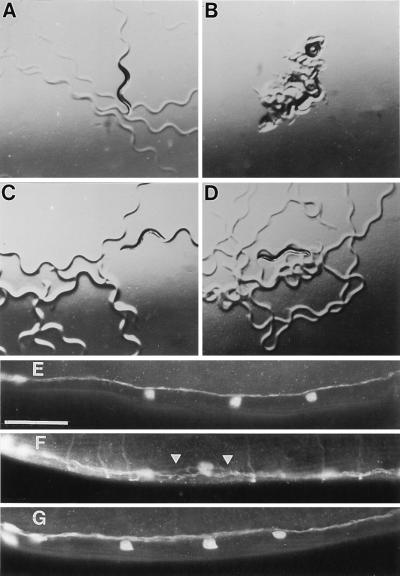
Restoration of locomotion and ventral cord fasciculation in unc-76(e911) worms by FEZ1. (AD) Animals were photographed after 1 h on slightly dried agar plates without bacteria. (A) Wild type; (B) unc-76(e911); (C) unc-76(e911) carrying the C. elegans unc-76 gene in p76–16B; (D) unc-76(e911) carrying the human FEZ1 gene in p76-HsA-5. (E-G) Ventral nerve cords just posterior to the heads of adults stained with anti-GABA antisera. Anterior is at the left. (E) Wild type; (F) unc-76(e911); (G) dpy-20(e1292ts); unc-76(e911) carrying the human FEZ1 gene in p76-HsA-5 and the C. elegans dpy-20 gene. Arrowheads, regions of defasciculation. Axons perpendicular to ventral nerve cord in F are motor commissures, out of the plane of focus in E and G. (Bar = 5 μm.)

References

    1. Tessier-Lavigne M, Goodman C S. Science. 1996;274:1123–1133. - PubMed
    1. Hedgecock E M, Culotti J G, Thomson J N, Perkins L A. Dev Biol. 1985;111:158–170. - PubMed
    1. Desai C, Garriga G, McIntire S L, Horvitz H R. Nature (London) 1988;336:638–646. - PubMed
    1. McIntire S L, Garriga G, White J, Jacobson D, Horvitz H R. Neuron. 1992;8:307–322. - PubMed
    1. Brenner S. Genetics. 1974;77:71–94. - PMC - PubMed

Publication types